
|
 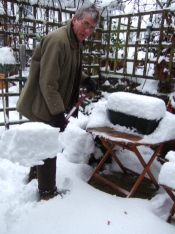 As
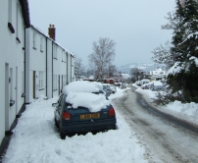
well as shoveling snow, we
are hard at work putting the final touches to some exciting new fishing
experiences for you in 2009. As
well as shoveling snow, we
are hard at work putting the final touches to some exciting new fishing
experiences for you in 2009.We would also like to tell you about the books, videos and websites that are keeping us going through long cold winter evenings.
We look forward to meeting you again in 2009. Please do not hesitate to contact us if we can be of any assistance. Paul Kenyon and Geoff Stephens |
 This
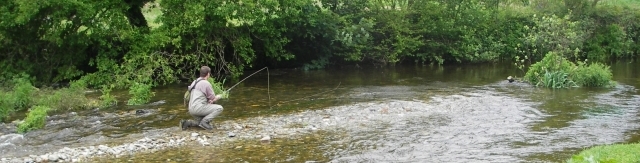
course will introduce you to fishing for wild
brown trout on small Dartmoor streams. It's not easy, but
this is the type of fishing that we - as instructors - enjoy because it
requires an amalgamation of field craft,
precision and experience.
This
course will introduce you to fishing for wild
brown trout on small Dartmoor streams. It's not easy, but
this is the type of fishing that we - as instructors - enjoy because it
requires an amalgamation of field craft,
precision and experience.This course is based at Bovey Castle Hotel near Moretonhampstead. Many of you will know the hotel's lakes where we introduce beginners to fly fishing. Less well known is the River Bovey which runs through the hotel's grounds and provides a convenient - if challenging - introduction to the skills required to outwit Dartmoor's wild brown trout.
The day begins on the lakes with revision of the roll cast and teaching you single-handed Spey casts - an essential skill to get the most enjoyment out of small stream trout fishing.
Then we move to the river. We will describe how to spot likely trout lies, which casts to use to present a fly, the importance of examining the insects present on the river bed, and what to do if no fish are seen rising.
Tuition is provided on a one-to-one basis. Maximum group size is two people. We can supply a suitable rod, reel, line and flies. We recommend clients bring chest or waist waders to cope with deeper sections of the river. If necessary, we can supply waders; please tell us your boot size in advance.
 Course price:
- half-day (three hours): £70 per person
- full-day (six hours): £130 per person
- permit to fish the lakes and river on the Bovey Castle estate: £10 per person
Lunch is available in the hotels informal Bistro, or why not take afternoon tea on the terrace overlooking the gardens.
 Worried
about leaving friends and family while
you go fishing? Relax.
Worried
about leaving friends and family while
you go fishing? Relax. They are more than welcome to enjoy the Bovey Castle's outstanding facilities which include:
a spa; horse riding; a golf course voted England's Finest Golf Resort at the World Travel Awards in 2008,
and walks around the beautifully restored Edwardian gardens.
Accommodation
If you require accommodation, these lodges are conveniently located within the grounds of Bovey Castle Hotel. They can be booked through Helpful Holidays.
 Lodge #1 in grounds of Bovey Castle |
 Lodge #2 in grounds of Bovey Castle |
 Lodge #3 in grounds of Bovey Castle |
 Lodge #3 in grounds of Bovey Castle |
 Fur,
Feather and Fin Day
Fur,
Feather and Fin DayWe designed our Fur, Feather and Fin Day with a question in mind:
"What would we like to do on a
special occasion?".
We came to the conclusion that it would be fun to combine a new activity with something that we already enjoyed.
Named after a famous series of books about country sports, our Fur, Feather and Fin Day encompasses:
- hunting with Harris hawks
- tying trout flies
- catching trout on a fly
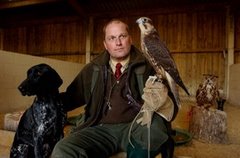 It's a lot to pack into one day, but after all
you will only do it once
in a blue moon.
It's a lot to pack into one day, but after all
you will only do it once
in a blue moon. To really enjoy the day we would recommend that you are already reasonably competent with a fly rod.
Regard it as a relaxing day in the countryside, rather than a day of intensive instruction. However, you will undoubtedly learn some new skills.
If this tickles your fancy, here are some more details.
 |
Ever since he
was a boy - taken under the wing of an eccentric uncle to
fish on Loughs Sheelin and Corrib - Paul has hankered after his own
Kelly Kettle. The Kelly Kettle was first used by ghillies in the west of Ireland in the 1890s. It consists of a double-walled chimney with the water contained in the chimney wall. "Tradition dictates that both the Ghillie and his guests (usually 2 anglers to his boat) together would gather dry tinder for the kettle from the lake shore. Then, the Ghille will set about boiling up the kettle which still amazes guests as it will even work in the height of a storm. The Anglers will then be offered their fresh tea and in return for his hospitality, the guests will share their lunch with the Ghillie." From History Of The Volcano Kettle Paul is convinced that water boils faster if he wears the appropriate headgear ! |
 |
Flies of the year
Angling writers often overlook small flies such as midges and small caddis in favour of larger and more glamorous flies. As Gary LaFontaine wrote, "A sad fact of modern fly-fishing is that so much of the lore is geared to one insect, mayflies ..".
Mayflies (ephemeroptera or upwinged flies) are found on Westcountry rivers, but they are outnumbered by glossosoma caddis and simulium midges. We have found artificial flies which represent these insects particularly effective this year. You can read more on this topic here ...
 |
 |
 |
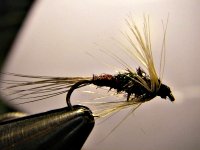 |
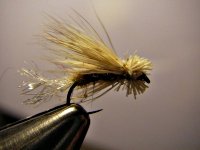
| Black / Green / Brown Sparkle Dun | Black Shipman's Buzzer | Black X Caddis | Cruncher |
| We use a 'comparadun' dressing in green and brown to represent hatching upwinged mayflies, and in black to represent hatching simulium midges. The combination of Antron tail, and deer hair wing imitates an emerging insect trapped in its nymphal shuck. | Shipman's Buzzer represents the larger midges - 'buzzers' - found on stillwaters. | We use Craig Mathews' Black X Caddis to represent the adults of Glossosoma caddis. | The Cruncher is a versatile wet fly that represents a variety of nymphs; it is productive on still as well as running waters. |
 Simulium larvae attached to river rock |
 Hatching midge at water surface |
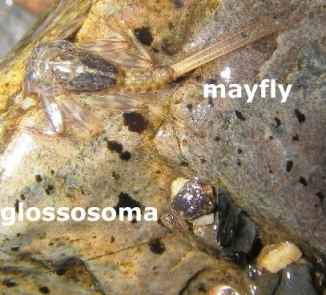 Glossosoma cased caddis and mayfly nymph |
|
Books of the year
This year's reading was dominated by the diminutive:
- John Gierach's "Fly Fishing Small Streams"
- Ed Engle "Fishing Small Flies"

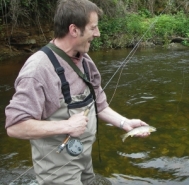 John
Gierach's "Fly Fishing Small Streams" is beautifully
constructed
mixture
of 'how-to' information and
mental approach to small
stream fishing. For example, Gierach has a refreshing approach to the
'lunker'
mentality:
John
Gierach's "Fly Fishing Small Streams" is beautifully
constructed
mixture
of 'how-to' information and
mental approach to small
stream fishing. For example, Gierach has a refreshing approach to the
'lunker'
mentality:"So let me introduce an idea - just something to kick around: Maybe your stature as a fly fisherman isn't determined by how big a trout you can catch, but by how small a trout you can catch without being disappointed, and, of course, without losing the faith that there's a bigger one in there". (From 'Fly Fishing Small Streams").
We are lucky because Dartmoor's rivers teem with small trout, which at times can be free rising and liberate childish delight in all of us. And there are occasional bigger trout in surprising places. Last season a colleague returned a 14" trout within yards of a normally busting tourist honey trap, and there is always the possibility of hooking a sea trout. Here's our take on the subject of brown trout size in local rivers.
Time is short in teaching sessions. We constantly feel under pressure to teach you purely mechanical skills - controlling wrist break or tying knots that won't slip. Just as important is the need for stealth when approaching and entering the water. Often the best thing to do is simply stand still and do nothing. But fifteen minutes of just standing and staring would be hard to justify in a short teaching session. Gierach devotes an entire chapter to this important topic which begins:
"I think stealth , and its
various manifestations rates it own chapter. It's an underrated skill
in fly fishing that's often listed after casting, entomology, wading,
and even fly tying in order of importance, but I could introduce you to
several fly fishers around here who can't cast worth a damn, don't know
a mayfly from a barn owl, and wade like buffaloes, but who still catch
lots of trout because they know how to sneak up on them."
Pure Gierach - seemingly effortless prose but used with deadly
precision.He has useful things to say about many topics including: etiquette, casting a dry fly downstream rather than the conventional upstream approach, the use of streamers - a very underused technique, and the perennial problem of choosing a rod for small stream fishing:
"I once worked in a fly shop and
the hardest thing I had to do there was help customers pick out fly
rods - customers who didn't know exactly what they wanted, that is.
What most chose to do was take every rod in the store out into the
parking lot for a test drive and then buy the one they could cast the
furthest with. I spent a lot of time, saying things like, "Well, that's
very nice, but most of the casts you'll be making around here will be
more like from here to that pickup truck, less than thirty feet -
sometimes considerably less."
How true, how very, very true. An awful lot of rods seem designed to
cast into the next county. And to emphasize how 'fast' they are, they
sport names that you normally see on the back of sports cars. Here are
some of our thoughts
on selecting suitable tackle.Gierach's chapter on fly selection is refreshingly honest. He describes two familiar stages of developing an appropriate fly collection that - believe me - we all go through: Stage 1 is 'thrashing around' collecting every fly known to man and buying ever-more complicated and expensive fly boxes. I have found myself seriously considering buying a box designed to keep water out, despite owning a much simpler fly box that was carefully constructed to allow water on flies to drain out! Some folk progress to Stage 2 which involves 'over-simplification' - a tiny collection of patterns based on the theory that trout in small streams are 'generalists' and will eat anything that floats past them. Or, as Gierach puts it:
If I absolutely had to go
fishing with only two flies, they'd be an Adams and a Hare's Ear Soft
Hackle, but lets not kid ourselves. Nobody goes fishing with just two
flies unless he's secretly using worms or trying to win a bet."
I confess to almost becoming stuck at this 'minimalist' stage of development. If you find yourself in a similar predicament, take a look at Ed Engle's "Fishing Small Flies".
This may help us progress to Stage 3 - Matching the Hatch.
One unique feature in Engle's book is the series of "Match the Life Cycle" diagrams that summaries the life cycle, patterns and fishing tactics for the types of insects we encounter on Dartmoor rivers and streams: ephemeroptera, midges, and microcaddis. We may not really need to closely match the hatch, but it helps boost confidence - and gives a new dimension to the richness of the fishing experience - if you have a rationale for using a particular fly presented in a particular manner.
 Engle devotes an entire chapter to the
importance of taking time to watch how
trout rise; this may give a clue as to the insects they are feeding on,
and
perhaps more importantly where they are feeding - taking insects on or
just below the surface. He draws on Marinaro's
distinction between simple, complex and compound rise forms and repeats
Marinaro's explanation that these different forms reflect the trout's
level of suspiciousness
about the (artificial) fly.
Engle devotes an entire chapter to the
importance of taking time to watch how
trout rise; this may give a clue as to the insects they are feeding on,
and
perhaps more importantly where they are feeding - taking insects on or
just below the surface. He draws on Marinaro's
distinction between simple, complex and compound rise forms and repeats
Marinaro's explanation that these different forms reflect the trout's
level of suspiciousness
about the (artificial) fly. I am a great admirer of Marinaro's work, but I might quibble with the idea that trout are suspicious. Certainly it looks like suspicion from a human point of view. But it's difficult see how this behaviour would have evolved in trout. I prefer the simpler explanation that variations in rise forms are due to the trouts' visual system, environmental factors such as the rate of current flow, and the structure of different insects. But then I am known as a bit of a pedant about this type of thing!
The important point is that Engle's chapter on observation together with Gierach's chapter on stealth and watercraft will help you get more enjoyment from your fishing.
Engle stresses simplicity in his choice of tackle. For example, he goes into great detail on leader design. But his open-mindedness shines through when he admits that he "still goes back and forth" about the merits of knotless over hand tied leaders. He gives the following down to earth advice:
"The key is to experiment with
different leader designs until you find one that works for normal
conditions where you fish."
 The problem of 'drag' figures prominently
throughout the
book. For example:
The problem of 'drag' figures prominently
throughout the
book. For example:"Drag is especially challenging
for small-fly fishermen because its effects can be more difficult to
detect when fishing a fly that may not be even visible on the water's
surface. The best course of action is to assume that drag exists on
anything but the shortest of casts and act accordingly. Consider your
position before the cast, use casts that put slack in the leader, and
if necessary, mend the fly line once it's on the water to counteract
drag."
Descriptions of the whole range of techniques that avoid drag and
achieve dead-drift presentation when fishing dry flies and nymphs are
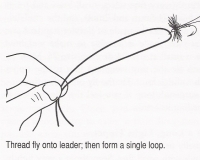
at the heart of Engle's book. Engle also reproduces the full instructions for tying the surgeon's loop or double-overhand loop knot which is used to attach the fly to the tippet. The fly is held within a loop at the end of the tippet. This reduces the 'lashing tail' effect which can occur with a conventional clinch or half-blood knot: A simple step but it may just make the difference between success and failure.
Further details of these two books can be found in Fly Fishing Devon's Bookshop in the category "Spring 2009 Newsletter recommendations"
DVDs of the year
 Spey to Z is described as follows:
"Spey to Z starts with the essentials of conventional single-hand overhead casts as pioneered by teaching greats like Mel Krieger, Joan Wulff, Bill Gammel, Bruce Richards, Al Kyte, and Macauley Lord. Spey to Z then takes the viewer through an easy to understand review of what key elements control overhead fly casts and how these elements relate to Spey casts with both single-handed and two-handed rods."
This video is an excellent tool for anyone wanting to learn how to Spey cast. The techniques can be utilized on small rivers and streams. I wish more videos would also show the cast from behind the angler's shoulder - rather than the more conventional side-on shots. This helps you understand what the cast should look like when you actually practice on the water.
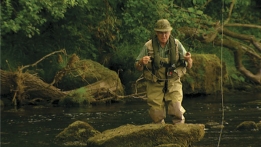 Oliver
Edwards:Upstream Nymphing and North Country
Spiders is described as follows:
Oliver
Edwards:Upstream Nymphing and North Country
Spiders is described as follows: "Most fishermen prefer wet fly fishing 'across and down', probably because it is an easy relaxing way to fish, but it is not the best way in my experience. I prefer to cast virtually square across the current using an upstream reach cast, holding the rod high I track it across my body allowing the spiders to drift with control not just swinging round in the current. This way I avoid those plucks and pulls and connect with many more fish."
I enjoyed this video because it transported me back to my early days fly fishing in Yorkshire (using a team of three wet flies: Greenwell's Glory, Snipe and Purple and Partridge and Orange ) swung 'across and down' and feeling for takes. Oliver Edwards describes some useful refinements to this basic technique. Wet flies are undergoing a resurgence of interest particularly in America. Americans call North Country Spiders 'Soft Hackles' or 'Flymphs', and anglers utilize the Leisenring Lift to represent nymphs and pupae rising towards the water surface. Books by Allen McGee and Sylvester Nemes are useful sources of further information. Details of these two books can be found in Fly Fishing Devon's Bookshop in the category "Spring 2009 Newsletter recommendations"
Websites of the year
- The Itinerant Angler Podcasts: A series of audio interviews with an interesting range of guests from the author and publisher Nick Lyons, to Jason Borger who has written the casting textbook and was stunt-double for Brad Pitt in the film A River Runs Through It.
- The Classic Fly Rod Forum: The participants are helpful, knowledgeable and well mannered in discussions about topics that can engender strong opinions e.g. the merits or otherwise of cane rods, reels, lines as well as fishing books and flies. Just don't ask for a second opinion on a rod being offered for sale on eBay !
 We
look forward to meeting you again when the snow clears!
We
look forward to meeting you again when the snow clears!Please do not hesitate to contact us if we can be of any assistance.
Paul Kenyon and Geoff Stephens
Fly Fishing Devon