
 |
 |
 |
 |
 |
 |
 |
|
Home page About us Instruction Guiding Locations map Gift vouchers Prices Articles Contact us Accommodation Links |
| The Upper
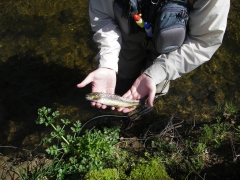
Yealm Fishery offers fishing for wild
brown
trout, sea trout and occasional salmon in peaceful surroundings near
Ivybridge which is a short distance from Plymouth
and popular holiday destinations in the South Hams.
The fishery lies hidden between two bustling transport arteries that serve the West Country. To the north the Penzance to Paddington railway line skirts the southern slopes of Dartmoor. The A38 dual carriageway between Exeter and Plymouth lies to the south of the fishery. When you emerge from the top of the upper beat there are views of a Brunel bridge in the distance and behind it a rampart of white china clay waste dug from pits at Lee Moor on Dartmoor that was used to produce English porcelain in the 18th century.
|
|
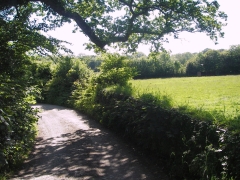 Access to the Upper Yealm fishery is easy. It is
remarkable
how quickly one can leave the hustle-and-bustle of everyday life
behind. Access to the Upper Yealm fishery is easy. It is
remarkable
how quickly one can leave the hustle-and-bustle of everyday life
behind.Don't worry about the narrow winding road; the locals are friendly and actually pause and thank you for considerate driving. If you tie your own flies you may not be able to resist the 'fur and feathers' roadkill along the way. Turn right at the 'Hump Bridge' road sign before 'Mark's Bridge', go down the track and park by the field gate. This really is parking for 'gentlefolk'. I'm more used to squeezing into the hedge; my car bears parallel scratches like a badge of honour. Go through the gate. Take a good look at it. You are unlikely to ever again see a farm gate in such fine condition in these parts. By now you should be lulled into a dreamy state like a child with a mug of Horlicks being read a bedtime story by Nanny. You are on the lower beat which I call the 'Schoolroom' because it is ideal for people who want to learn the basics of fishing for wild brown trout from scratch. |
||||||
|
|||||||
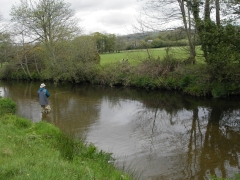
The lower
beat
runs along the edge of this meadow; a path and adjacent car parking
provide easy access to the fishing.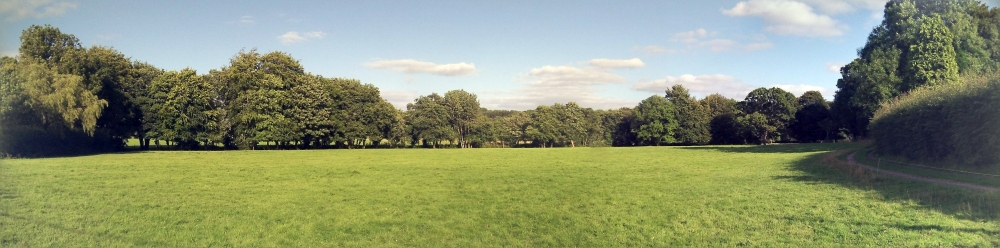 The meadow hosts a flock of noisy guinea fowl – more flytying material at your feet.  |
|||||||
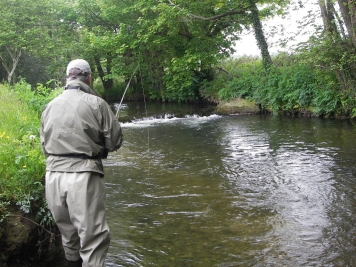
 Walk to the upstream corner of this meadow. This
is fishing
in miniature but none the worse for that. Bring a six to seven
foot rod and think 'roll cast'. The river deepens in
places against the far bank under a protective canopy of trees.
Use a Spey cast to align the end of the fly line with your
target. Walk down the meadow and the river opens out and slows as
it is held back by a weir built in the 18th Century to serve a
mill downstream at Lee Mill – long gone now.
Walk to the upstream corner of this meadow. This
is fishing
in miniature but none the worse for that. Bring a six to seven
foot rod and think 'roll cast'. The river deepens in
places against the far bank under a protective canopy of trees.
Use a Spey cast to align the end of the fly line with your
target. Walk down the meadow and the river opens out and slows as
it is held back by a weir built in the 18th Century to serve a
mill downstream at Lee Mill – long gone now.Yes, that dark shadow is a sea trout lying above the weir – and between May and September there may be more hidden beneath trees tight against the far bank. Walk on downstream past a succession of small but perfectly formed pools. Each hold brown and possibly sea trout, but they must be approached with extreme stealth and one's ability to cast accurately will be tested. Tie on disposable flies, you will get caught up and must be prepared to break off rather than disturbing the pool by crashing across it. You can always mark the spot and retrieve the fly later. You will catch fish. Small yes, but with occasional larger surprises and you have the possibility of a sea trout which in these conditions will be a memorable experience. When you have been lulled into a false sense of security you are ready to tackle the upper beat, or as I call it – the “Examination Room”.
 Walk
up the
road a few hundred yards to skirt the gardens of houses that back
onto the Yealm and pick up the river again by the bridge. Steps
have been cut into the bank to aid your descent. Echoes of that
fine gate. Enjoy the easy entrance – you are about to be
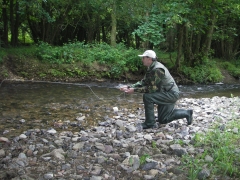
severely tested!. I don't need to tell you to crouch –
the overhanging limbs force you to become a human heron. The
pools are even smaller now but some are deceptively deep. Creep
upstream. Forget about overhead casts. Just remember to never
allow the fly to travel above your head and you will simply loose
a small fortune's worth of flies, rather than face total
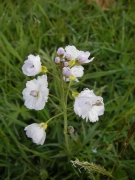
financial meltdown ! Go quietly up this stretch and pause to take
in the banks of wild flowers and the animals that pass you
by.
Walk
up the
road a few hundred yards to skirt the gardens of houses that back
onto the Yealm and pick up the river again by the bridge. Steps
have been cut into the bank to aid your descent. Echoes of that
fine gate. Enjoy the easy entrance – you are about to be
severely tested!. I don't need to tell you to crouch –
the overhanging limbs force you to become a human heron. The
pools are even smaller now but some are deceptively deep. Creep
upstream. Forget about overhead casts. Just remember to never
allow the fly to travel above your head and you will simply loose
a small fortune's worth of flies, rather than face total
financial meltdown ! Go quietly up this stretch and pause to take
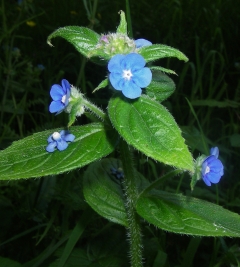
in the banks of wild flowers and the animals that pass you
by.The owners of Upper Yealm fishery - Josh and Julie Dalton - are welcoming and friendly. The fishery has an autumn run of salmon and the Yealm salmon season ends on 15th December.
| "The Yealm, occasionally in old times written as 'Ye Alm', rises in boggy ground forming the watershed between it and one of the tributaries of the Plym and flowing southwards through the lovely gorge of Hawns and Dendles, quickly reaches the fertile meadows of the Blachford valley. Continuing it's course through the country, every yard of which is beautiful, it arrives, after being augmented by the Piall from the Delamore and Slade valley, at the tidal waters of the estuary between Puslinch and Kitley, some thirteen miles from it's source." (written by John Duke Pode and Cyril Augustin Pode in 1918) | ||
| Further information | ||
 |
|
 |
 |
 |
 |
 |
 |