
 |
 |
 |
 |
 |
 |
 |
|
Home page About us Instruction Guiding Locations map Gift vouchers Prices Articles Contact us Accommodation Links |
| Stealth
Part 1:
The importance of
(in)visibility to the trout fisher |
|
 |
Flyfishers
understand that they should take care to make sure they are not seen by
trout. This page explores the question "What is a safe distance?". If we apply a bit of maths - and some common sense - it turns out that a useful "rule of thumb" is:
|
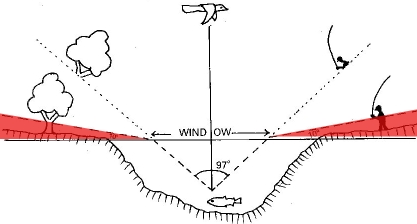 |
Because of
the laws
of refraction, fish cannot see any part of an object which lies below
an angle of 10 degrees to the water surface at the edge
of their "window". The red triangles in this diagram show this "blind spot" extending outwards all around the edge of the trout's window. [ Diagram adapted from Fig. 6 in Professor L T Threadgold's book "Dry Flies: An Improved Method of Tying" see Ref#2 ] The next set of pictures apply this law of refraction to show the effect of standing upright and crouching on an angler's visibility to trout . |
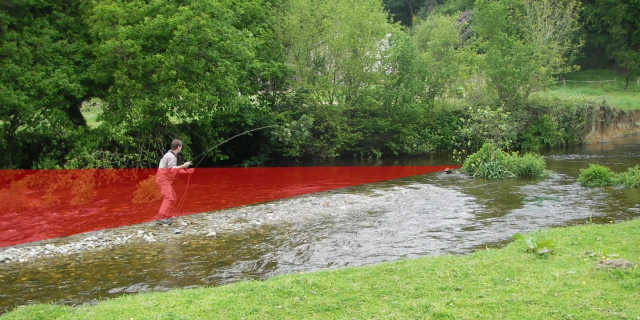 |
The head and
upper body of the standing angler would be
visible to a trout lying
beside the clump of midstream vegetation on the right hand side of the
photograph. (The triangles in these picture were created using GIMP see Ref#3. The calculations were made using an online calculator see Ref#1.) |
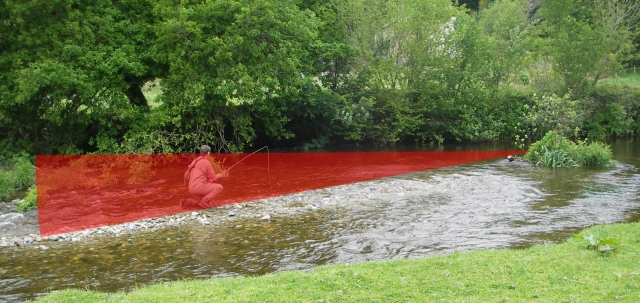 |
But if the angler crouches, only his head would be visible to a trout lying beside the clump of midstream vegetation on the right hand side of the photograph. |
| We can begin to answer our question: What is a safe distance? | ||
| Angler is: | Height of angler (in feet) | Distance angler invisible to trout (in feet). Based on calculation made with aid of Ref#1 |
| Standing | 6 feet | =>34 feet |
| Crouching | 4 feet | =>23 feet |
| Things to bear in mind: This doesn't mean you need to have 23 or 34 feet of fly line outside your rod tip, because:
Assuming your leader straightens out, and you hold the rod straight out in front of you with the tip at water level:
|
 Image from Ref#4 |
References:
- Right Triangle Angle And Side Calculator
- Professor L T Threadgold. "Dry Flies: An Improved Method of Tying", Swan Hill Press, Shrewsbury, 1998
- GIMP the GNU Image Manipulation Program
- How Does a Trout Catch a Fly?: Marinaro's "Edge of the Window Theory"
|
Copyright
Paul Kenyon 2008-2016
If you like our website, please consider recommending it on Google +1
|