vanilla-menu-plus-social-media
Home page
About us
Instruction
Guiding
Locations map
Gift vouchers
Prices
Articles
Contact us
Accommodation
Links
|
What
do the scientists
tell us about the size of fish in a typical Dartmoor river?
John Gierach's
book "Fly Fishing Small
Streams" is a beautifully constructed
mixture of 'how-to' information and mental approach to small stream
fishing. Gierach has a refreshing approach to the increasing tendency
to equate fishing quality with the size of fish caught. For example, "..
let me introduce an idea -
just something to kick around: Maybe your stature as a fly fisherman
isn't determined by how big a trout you can catch, but by how small a
trout you can catch without being disappointed, and, of course, without
losing the faith that there's a bigger one in there".
(From 'Fly Fishing Small Streams").
We
are lucky because Dartmoor's rivers teem with
small trout, which at times can be free rising and liberate
childish delight in all of us, and I have written several essays on the
size
of trout
in Dartmoor's rivers. But my comments were based on the size of fish
caught
by anglers. What do scientists
tell us about the size of fish in a typical Dartmoor river?
Recently
my attention was drawn to an electro fishing survey carried
out in 1962 on the River Avon in South Devon. Nine sites were sampled,
a stop net was placed across the
downstream limit of each survey section, electro fishing was repeated
until the operators were satisfied that no more fish remained, the
catch was transferred to an oxygenated holding tank and each fish
measured to the nearest quarter (1/4) inch. Full report available
here ...
|
The results are shown in this figure.

The results show that:
- most trout were less than 8 inches long. In
1962 all trout below 8" had to be returned, but anglers could take home
fish over 8"
- there were very few fish over 10" - in fact
they were as 'rare as hen's teeth'.
- but one fish was 18 inches in length - which
echoes Gierach's point that we shouldn't lose the faith that there's a bigger
one in there
The next graph shows the growth rate of wild brown trout in our area.
- fish of 12 to 14 inches take six years to reach
that length
- our trout are about 7 inches long when they
spawn for the first time at 3-4 years of age
(Data from Frost and Brown, "The Trout", published by Collins, London
1967, Appendix III, row 22)
Combining these results shows that:
- less than half of the trout
stock were capable of reproduction
- most trout were younger than 3 years and less
than 7 inches long.

According to the Wild Trout Trust "A typical female brown trout
produces about 2,000 eggs per kilogram (900 eggs per pound) of body
weight at spawning".
But
- mortality is especially high in the period
between hatching from the egg to establishing a territory
- only 20 fish reach their first
birthday
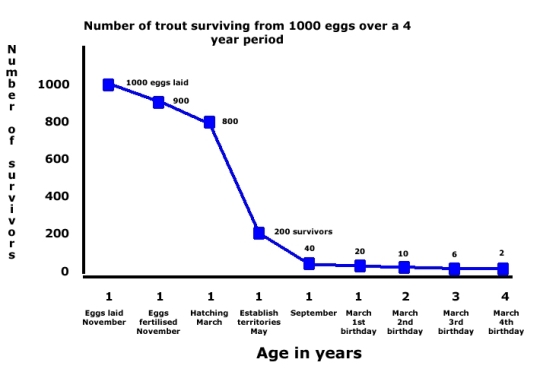
So, the next time you hear someone complain about
the small size of the
fish they are catching, remind them that an eight inch fish is
probabaly three years old and is one of a group of maybe only six fish
that remain from a clutch of 1000 eggs!
Sources:
- Frost and Brown, "The Trout", published by
Collins, London
1967 (appendix III, row 22)
- The Wild Trout Trust 'Trout Facts'
- Watson, "The Trout: A Fisherman's Natural
History",
published by Swan Hill Press, Shrewsbury, 1993
Copyright Paul
Kenyon 2016
Recommend
this article on Google |
|
|