Seminar
readings:
- Buss, (1995).
"Psychological sex
differences: Origins through sexual selection".
- The
Evolutionist "In
conversation with David Buss"
- Hewett (2002)
"Theory of Sexual
Selection: The Human Mind and the Peacock's Tail"
- Miller (1998)
"Sexual
Selection and the Mind" - interview with Miller in Edge magazine on May
26th 1998
- Kanazawa (2000).
"Scientific
discoveries as cultural displays: a further test of Miller's courtship
model". Evolution and Human Behavior, 21, 317-321, 2000.
|
- Miller
(2000) "The
Mating Mind: How Sexual Choice Shaped the Evolution of Human Nature
- Chick (1998)
"What is Play For?
Sexual Selection and the Evolution of Play"
- Wilson
and Daly (1998)
"Lethal and nonlethal violence against wives and the evolutionary
psychology of male sexual proprietariness"
- Daly and
Wilson (1996) Evolutionary
psychology and marital conflict: the relevance of stepchildren"
- Daly
and Wilson (2001). "Risk-taking, Intrasexual
Competition, and Homicide".
|
The
status of sexual selection in
evolutionary psychology

|
View the PBS (2001)
Evolution video "Sex" to get an overview of
the factors involved in sexual selection
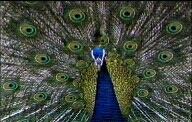
The
peacock fascinated Darwin:
How could natural selection alone have led to such an elaborate
plumage? Surely such an encumbrance would have jeopardized the bird's
survival?
He proposed that secondary
sexual characteristics of male animals evolved because
females preferred to mate with individuals that had those features.
Darwin wrote: "[Sexual
Selection] depends, not on a struggle for existence (i.e.
natural selection), but on a struggle between the males for
possession of the females; the result is not death to the unsuccessful
competitor, but few or no offspring." Charles Darwin, Origin of Species
(1859). Italics mine
View the PBS (2001)
"Tale of the Peacock" video featuring Petrie's work on
peacock tail feathers.
"Peahens often choose males for the quality of their trains -- the
quantity, size, and distribution of the colorful eyespots. Experiments
show that offspring of males with more eyespots are bigger at birth and
better at surviving in the wild than offspring of birds with fewer
eyespots."
In
this short video by Richard Dawkins
discusses how phenotypes and extended
phenotypes play an important role in
sexual selection
|



|
In
essence, sexual selection can
operate through two mechanisms:
- intersexual
selection: competition between members of the opposite
sex, e.g.
- females
and males choosing to mate with 'attractive' mates = 'selective mate
choice'
- 'male
sexual proprietariness' over females to protect against undetected
cuckoldry
- intrasexual
selection: competition between members of the same
sex e.g.
- males
competing with each other for access to females
 |
In
these examples of intersexual selection
-selective mate choice
- a
female Satin Bower Bird inspects an avenue of twigs a foot or so apart
constructed by the male which has bright shiny blue feathers. The male
arranges blue objects in front of this avenue in order to attract a
mate. Notice the sexual dimorphism in this species - a brightly
coloured male bird courts a relatively dowdy female
- a
male suitor presents a woman with a token of his affection
|
 |
 |
Familiar
examples of males competing with each other for access to females -intrasexual
selection- include:
- stags
fighting during the rutting season
- the
creation and maintenance of 'dominance hierarchies'
- and
possibly, the tendency of young men to engage in risk taking and
inter-male aggression
|
|
Frequently
inter- and intrasexual
selection behaviours are exquisitely intertwined.

This picture shows a modern re-enactment of medieval joust in which two
knights charge at each other on either side of a central barrier with
the aim of unhorsing their adversary with a lance in order to win their
lady's favour |
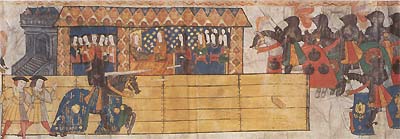
Inter- and intrasexual
selection? In medieval times knights swore to
uphold the values of courage and courtesy. Henry VII built a 'tiltyard' at Hampton Court where
he could joust with his courtiers as they recreated the chivalrous
exploits of medieval knights such as the legendary Sir Galahad - a
member of King Arthur's court. The tiltyard had a
special grandstand built in the middle for the queen and the ladies of
the court to get a better view. The
winner of the jousts was awarded a prize by the 'Queen of Beauty',
elected for the occasion from amongst the women present.
|
Parental
investment and sexual selection
Darwin's (1871) theory of
sexual selection was developed further by Trivers
(1972) who argued that
because of parental investment, the sex
that invests greater resources in
offspring will evolve to be the choosier sex in selecting a mate.
In contrast, the
sex that invests fewer resources in offspring will evolve to be more
competitive with its
own sex for access to the high-investing sex.
- Normally females are the
limiting sex and invest more in offspring than males.
- Because males tend to be in
excess, males tend to develop ornaments for attracting females or
engaging other males in contests.
(In
some species the roles of the
sexes may be reversed. See Goodenough et al, 2001 Chapter 14 for a very
good description
of sexual selection in animals).
Buss
(1999 p 41) provides a clear
description of why evolutionary psychologists have applied Trivers'
theory of parental
investment to human mating:
"The
differences between men and women in terms of the fitness costs of
making a poor mate choice are profound. An ancestral man who made a
poor choice when selecting a mate could have walked away without
incurring much loss. An ancestral woman who made a poor choice when
choosing a mate might risk becoming pregnant and perhaps having to
raise the child alone, without help."
| The BBC
website "More Science About Lonely Hearts" provides a useful
introductory overview of some topics researched
by evolutionary psychologists interested in sexual selection.
You can listen to Lynn Segal, Professor of
Psychology and Gender Studies at Birkbeck College, London and Ruth
Mace, Lecturer in the Department of Anthropology at University College
London debate the contribution of evolutionary psychology to
contemporary attitudes to marriage and parenting. (BBC
radio broadcast as part of "Woman's Hour" on Wednesday 8 August 2001)
|
Human mating systems:
monogamous females and polygamous males - a myth?
There
are several technical terms used to
describe mating systems that can cause confusion. This table may help
to clear things up
or create more bewilderment - let me know!
|
|
| Mating
system |
Male  |
Female |
| Monogamy |
mates with one female |
mates with one male |
| Polygamy: |
|
| Polygyny |
mates with more than one female |
|
| Polyandry |
|
mates with more than one male |
| Promiscuity |
mates with more than one female |
mates with more than one male |
|
Answer these questions after
you have studied the table:
- Which of the following
terms can be applied to male mating
systems?
- monogamy
- polygamy
- polygyny
- polyandry
- promiscuity
- Which of the terms can be
applied to female mating systems?
- Which of the terms can only
be applied to female mating systems?
- Which of the terms can only
be applied to male mating systems?
Male and female attitudes to multiple sexual
partners
| Evolutionary psychology
suggests that males have evolved an approach to mating that leads them
to seek multiple copulatory partners. This prediction - based on
Trivers' theory of parental investment - is consistent with the
following observations: |
 |
- When
they are asked how many sexual partners they would like over a certain
period of time, men report that they would prefer more partners than
women,
- When
they are asked if they would agree to have sexual intercourse with an
attractive member of the opposite sex that they have known for varying
lengths of time, men and women express different likelihood's of
consent. Men reported that they would be slightly disinclined to have
intercourse with a woman they had known for just an hour. In contrast,
it is very unlikely that a woman would agree to intercourse after
knowing a man for this length of time. Source: Buss & Schmidt, Psychological
Review , 100, 204-232, 1993
|
|
|

|

|
| A note of caution; These
results are based on what men and women say about their desires and
preferences. People's replies to questions about what they think they
would do should be treated with caution. Researchers need to be wary of
demand characteristics influencing
participants' behaviour. Demand characteristics refer to participants
awareness of experimenters' goals or cultural expectations influencing
participants responses. See Mace (2000) for a discussion of this
confounding factor in evolutionary psychology research.
Another problem with
this type of prospective questionnaire in
which people say what they might do is
that it does not show that the behaviour has a measurable outcome on
reproductive fitness. Contrast this research technique with that
adopted by Pawlowski, Dunbar and Lipowicz (2000)
who examined the medical records of nearly 4,500 Polish men
aged between 25 and 60. They found that men who had fathered at least
one child were on average three centimetres (1.25 inches) taller than
men who had not fathered children. You can listen to a radio interview in which Dunbar
discusses various explanations for this result.
|
Short-term mating: "A
dance between the sexes?"
|
 Although
the data (Buss & Schmidt, 1993) suggest that - compared to females - males
would like to mate with more partners over time, it does not
support the hypothesis that females are exclusively monogamous.
If you look carefully at the graph you will see that females would like
more than one partner in the next three years. This opens up the
possibility that a male may be cuckolded
and consequently waste his parental investment.
Bear this in mind as you progress through the readings on this page.
These factors may be relatedness to 'male sexual
proprietariness' which has been used to explain domestic
violence which
is discussed below. Although
the data (Buss & Schmidt, 1993) suggest that - compared to females - males
would like to mate with more partners over time, it does not
support the hypothesis that females are exclusively monogamous.
If you look carefully at the graph you will see that females would like
more than one partner in the next three years. This opens up the
possibility that a male may be cuckolded
and consequently waste his parental investment.
Bear this in mind as you progress through the readings on this page.
These factors may be relatedness to 'male sexual
proprietariness' which has been used to explain domestic
violence which
is discussed below.
Also examination of
these
results suggests that whereas:
- men
reported that they would be slightly disinclined to have intercourse
with a woman they had known for just an hour
- women
reported that they would be slightly disinclined to have intercourse
with a man they had known for three months
|

|
|
 It is often claimed by
evolutionary psychologists that the cost of mating for men are
relatively slight. For example: "A man in human evolutionary history
could walk away from a casual coupling having lost only a few hours or
even a few minutes." (Buss, 1999, p102). But the interview-data
suggests that men may have to invest between three and six months in
courtship behaviours before they get the opportunity to mate. Whilst
this is much less than the nine months a woman devotes to pregnancy
plus the years of postnatal care, there is nevertheless a greater cost
to the male than is sometimes implied. The pre-mating costs for men
seem to have been discounted by evolutionary psychology.
It is often claimed by
evolutionary psychologists that the cost of mating for men are
relatively slight. For example: "A man in human evolutionary history
could walk away from a casual coupling having lost only a few hours or
even a few minutes." (Buss, 1999, p102). But the interview-data
suggests that men may have to invest between three and six months in
courtship behaviours before they get the opportunity to mate. Whilst
this is much less than the nine months a woman devotes to pregnancy
plus the years of postnatal care, there is nevertheless a greater cost
to the male than is sometimes implied. The pre-mating costs for men
seem to have been discounted by evolutionary psychology.
 A small,
but significant, proportion of women in long-term relationships engage
in short-term matings (see figure). There must have been some selective
advantage for women to engage in short-term mating otherwise the
inclination to engage in this behaviour would never have had a
selection advantage for men. Buss (1999)
distinguishes between different types of explanations for female
short-term mating that have some experimental support in the human and
animal literature:
A small,
but significant, proportion of women in long-term relationships engage
in short-term matings (see figure). There must have been some selective
advantage for women to engage in short-term mating otherwise the
inclination to engage in this behaviour would never have had a
selection advantage for men. Buss (1999)
distinguishes between different types of explanations for female
short-term mating that have some experimental support in the human and
animal literature:
- acquisition
of resources from males
- acquisition
of a genetic resource e.g. the 'sexy son hypothesis' allows female to
bear a son with her genes who will attract females in the next
generation
- 'mate-switching':
dealing with a long-term partner who is resource-poor

 To
sum up, I would suggest that the notion of monogamous
females and polygamous males is a myth. I would suggest
that there is more symmetry in the costs and benefits of short-term
mating for both sexes than hitherto acknowledged. It would advantage
the inclusive fitness of both males and females to engage in short-term
mating where the partner offers 'good biology', and any offspring would
be sufficiently resourced to ensure their survival to reproductive age.
Thus:
To
sum up, I would suggest that the notion of monogamous
females and polygamous males is a myth. I would suggest
that there is more symmetry in the costs and benefits of short-term
mating for both sexes than hitherto acknowledged. It would advantage
the inclusive fitness of both males and females to engage in short-term
mating where the partner offers 'good biology', and any offspring would
be sufficiently resourced to ensure their survival to reproductive age.
Thus:
- a man can increase his
inclusive fitness by engaging in short-term mating provided his mating
partner has 'good biology', and access to sufficient resources to
promote the survival and reproductive success of his
child.
- short-term mating can
increase an unpartnered woman's inclusive
fitness provided her mating partner has 'good biology', and she
has access to sufficient resources to promote the survival and
reproductive success of her child(ren).
- short-term mating can
increase a partnered woman's inclusive
fitness provided her mating partner has 'better biology' than her
long-term partner, and she does not loose access to sufficient
resources to promote the survival and reproductive success of her
child(ren).
This analysis suggests the
following hypotheses about the attitudes of genetic
relatives to short-term mating:
- a man's relatives can increase
their inclusive fitness by permitting / encouraging him to engage in short-term
mating particularly if the woman has access to
sufficient resources to promote the survival and reproductive success
of his child.
- a woman's relatives can increase
their inclusive fitness by permitting / encouraging her to engage in short-term
mating IF her mating
partner has 'good biology', and she has access to sufficient resources
to promote the survival and reproductive success of her child(ren).
- a woman's relatives can jeopardize
their inclusive fitness by permitting / encouraging her to engage in short-term
mating IF she does not
have access to sufficient resources to promote the survival and
reproductive success of her child(ren).
- To date most attention has
been focussed on hypothesis# 3 - the
control exerted over women's reproductive potential.
- Hypothesis# 1
reflects the 'double-standard' over men's sexual adventures
e.g. young men 'sowing wild oats'.
- Hypothesis# 2
is controversial but it seems to follow from the theory of inclusive
fitness. Certainly the literature focusses on measures taken to control
women's short-term mating. But under certain circumstances the benefits
of short-term mating might outweigh the costs, for example in
situations where there was a scarcity of long-term mating
opportunities, or where short-term mating could be kept secret from
long-term mates. As far as I know there is no experimental evidence for
or against hypothesis# 2.
Long-term
mating:"A battle between the sexes"?
In a groundbreaking study of long-term
mating strategies involving 10,047 participants from 33
countries Buss (1989)
showed that:
- Males
prefer young, physically attractive,
and chaste mates.
- Females
place greater emphasis on the earning capacity
and ambitiousness-industriousness of
potential partners than men do.
It is interesting that the
commentary elicited by this paper focussed on alternative explanations
involving economic powerlessness for the female preferences. The
findings on male desires did not provoke a spate of alternative
explanations based on cultural interpretations to challenge the
evolutionary explanation. Buss (1989) and Buss' responses to peer
commentaries are both available
online
According to conventional
evolutionary psychology (e.g. Buss, 1996)
these psychological differences between the sexes evolved
because the adaptive problems posed by
reproduction are different for
men and women. However, if we
examine the adaptive problems posed by long-term mating there
is remarkable symmetry between the
problems faced by the sexes:
- Both men and women
need to select mating partners with 'good biology',
i.e. to maximize fitness both sexes need to mate with fertile,
healthy partners who are likely to produce fertile, healthy
children.
- Both men and women
need to mate with partners who will remain 'faithful'
i.e.
- Women need to
select men able and willing to provide resources
(physical and behavioural) to promote the survival and reproductive
success of her child(ren),
AND
- Men need to
select women able and willing to provide resources
(physical and behavioural) to promote the survival and reproductive
success of his child(ren)
- this particular point is implied, but not stressed, by the
evolutionary psychologists I have read.
|
 |
| 'Good
biology' or 'good genes'
Today's
paper carries a story headed "Technological advances may lead to
genetic apartheid, says scientist" (Akbar 2003).
"Sir
Paul Nurse, a Nobel prize-winner, who is the chief executive of cancer
research UK, predicts that in 20 years' time, it will be technically
possible to sequence the genome of each new baby." I read this and
wondered if a 'genetic identity card' might be an essential piece of
equipment for future generations steeped in evolutionary psychology
setting off to secure a 'one-night-stand'. But I am not convinced that
being armed with a person's genome would provide better clues to their
'good genes' than relying on the adaptations that have evolved to spot
fit short- and long-term partners.
I
have used the phrase 'good biology' in previous sections rather than
the more common expression 'good genes' after reading Keller (2000).
Keller's book is well worth reading if you are seeking answers to
questions such as "What does a gene do?" (see chapter 2) or "What are
genes for?" (see Conclusion). Genes are important for evolutionary
psychology because they permit the transmission of evolved adaptations
from parents and offspring (Buss 1999). However the term 'gene' is
borrowed from biology, and recent advances in molecular biology suggest
that the concept 'gene' is either very difficult to tie down, or has
now outlived its usefulness (Keller pp 66-72). Way back in 1953, Watson
and Crick's description of DNA's double helical structure lent support
to the idea that one gene controlled the production
of one enzyme. Abnormalities in a single gene are
known to give rise to severe disorders such as Huntington's disease or
phenylketonuria (PKU). This simple picture was captured by Francis
Crick who stated in 1957
"DNA makes RNA, RNA
makes protein, protein makes us." (See Keller., p 54).
But
this simple theory left open the question of what regulates the genes
to control the time, place and amount of protein production. All cells
have a nucleus with a full set of genes, but all cells do not produce
all the potential proteins that they are capable of manufacturing all
of the time. In 1959 Jacob and Monod suggested a distinction between 'regulator'
and 'structural' genes to deal with this problem. It
has been suggested that 97% of the human genome is involved in
regulating the 3% of genetic material that actually builds protein. The
discovery in 1977 that genes are fragmented along a chromosome and
interspersed with lengths of 'junk DNA' opened up the possibility that
the variety of protein constructed from DNA can vary during an
organism's life (see section on 'alternative splicing', Keller p 60).
Consequently, the notion of 'one gene - one protein' has been abandoned
to be replaced by 'one gene - many proteins'.
Perhaps the most unsettling message for evolutionary psychology from
molecular biology comes from recent 'knockout'
studies in which specific genes are disrupted in an intact animal. "In
many cases, knocking out a normal gene and replacing it with an
abnormal copy had no effect at all, even when the gene was thought to
be essential..." (Keller 2000, p 112). These results have added to the
belief that there is extensive redundancy built
into an animal's DNA.
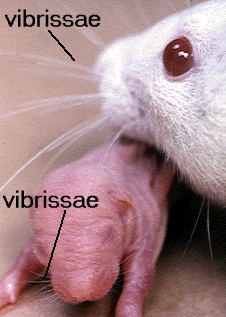
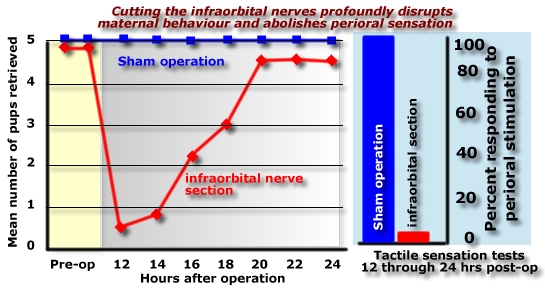
Redundancy
is a recurring familiar feature of biological systems. For example, our
own work (Kenyon et al.1983)
on retrieving behaviour in rats revealed that although cutting the
infraorbital branch of the trigeminal nerve - which transmits tactile
sensation from vibrissae to the brain - severely disrupts retrieving
behaviour for about 12 hours, this complex behaviour returned to normal
24 hours post-operatively even though tactile sensation was abolished.
Thus the mother rat was able to utilize some other (redundant?) system
to enable her to carry out this vital maternal behaviour.
|
Seminar
readings:
The paper by Buss,
D. M. (1995). "Psychological sex differences: Origins through sexual
selection". American Psychologist, 50, 164-168, available online provides a short
and clear explanation of sexual selection seen through the eyes of an
evolutionary psychologist. As you read the paper consider the following
points:
- Where, in broad terms, do
evolutionary psychologists predict we will find sex differences in
behaviour?
- Describe, in your own
words, the two forms of sexual selection.
- Briefly outline five
hypothesized sex differences in behaviour predicted by evolutionary
psychology.
- How to calculate Cohen's
'd' statistic is described by Thalheimer and Cook
( 2001-2003,). "How to calculate effect sizes from published research
articles: A simplified methodology" Work-Learning Research, Somerville,
Massachusetts, USA, available online
- Make a list of behaviours
which exhibit large and small
effect-size differences between the sexes.
Read The Evolutionist
"In conversation with David Buss" which is available online and consider the
following points:
- What are the differences
between male and female short- and long-term mating strategies?
- What does Buss mean when he
remarks that "Some people have conflated the causal process that
produces adaptation with the nature of adaptation itself."?
- Why has there been a
relatively slow take up of evolutionary ideas within psychology?
- Can you give evidence to
support the jibe that "if a social scientist witnesses something that
looks like a duck, walks like a duck, and quacks like a duck, then he
says it's a social construction of a duck."?
- Can evolutionary psychology
explain the sexual revolution that occurred in the 'swinging 60s'?
- What is a 'New Man' and can
it be explained in terms of evolutionary psychology?
- Can 'lad' and 'ladette'
culture be explained in terms of evolutionary psychology?
Read Hewett
(2002) "Theory of Sexual Selection: The Human Mind and the Peacock's
Tail" (online article) and consider the
following points:
- Explain
Fisher's view that the peacock's tail is the product of 'runaway'
sexual selection.
- Zahavi
views the peacock's tail as a handicap. How then could it evolve?
- What
is the 'lek paradox', and how can it be resolved?
- Why
did the human brain evolve to be so big?
 |
Read the interview
(Sexual Selection and the Mind) with Miller in Edge
magazine on May 26th 1998 (available online). This article
provides an accessible introduction to Miller's view of the role of sexual
selection in the evolution of human behaviour. As you read
the article consider the following points: |
 |
- How
is Miller's approach to explaining the evolution of human behaviour,
different from mainstream evolutionary psychology?
- What
behaviours does Miller focus on? Can these be explained by evolutionary
psychology?
- Explain
the terms: mate choice, natural selection, sexual selection, human
'universals', tabula rasa,
- Can
evolutionary psychology explain variation in intelligence? If not, why
not?
- Are
there important differences between male and female psychologies?
- Does
pulverizing the tabula rasa take pressure off
parents trying to raise children?
- To
what extent is the concept of sexual selection central to the
psychology you have studied as an undergraduate?
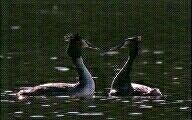 Most of
you will have engaged in courtship behaviour at some time in your
lives. How much have you learnt about this behaviour as a psychology
student? Look up 'courtship' in the index of several psychology
textbooks. How much would you learn about this behaviour in humans
if you read psychology texts? Look up 'cerebellum' in the index of
several psychology textbooks. How much would you learn about this
structure if you read psychology texts?
Most of
you will have engaged in courtship behaviour at some time in your
lives. How much have you learnt about this behaviour as a psychology
student? Look up 'courtship' in the index of several psychology
textbooks. How much would you learn about this behaviour in humans
if you read psychology texts? Look up 'cerebellum' in the index of
several psychology textbooks. How much would you learn about this
structure if you read psychology texts?
- What
factors are thought to influence mate choice? See also Buss (1999)
- Why
do we speak?
- How
would you test the hypothesis that vocabulary size has been shaped by
sexual selection?
- Why
do we make, and enjoy, music?
- Should
scientists studying human behaviour be worried about the implications
and applications of their findings?
 Read Kanazawa
"Scientific discoveries as cultural displays: a further test of
Miller's courtship model". Evolution and Human Behavior, 21, 317-321,
2000. (Available from library offprints collection) which describes an
empirical study based on Miller's theory. As you read this paper
consider the following points:
Read Kanazawa
"Scientific discoveries as cultural displays: a further test of
Miller's courtship model". Evolution and Human Behavior, 21, 317-321,
2000. (Available from library offprints collection) which describes an
empirical study based on Miller's theory. As you read this paper
consider the following points:
- Outline
Miller's courtship model.
- What
were the hypotheses in Kanazawa's study?
- Do
you think that "men compete for their mates much more fiercely than
women"? What are the implications of your answer for the study of
sexual selection in human behaviour?
- What
were the independent and dependent variables in Kanazawa's study?
 |
Here are rough graphs
showing some of the results presented by Kanazawa. You can use this
'slide projector' to display the age distributions of peak scientific
achievement for:
- married or
- unmarried
male
scientists
Kanazawa
reported a significant difference in the mean age between the married
and unmarried scientists. What statistical test would you carry out to
determine if the distributions of the age of peak scientific
performance are significantly different between married and unmarried
scientists?
|
- Can
you think of alternative explanations for the relatively few female
scientists in Kanazawa's sample?
- Can
you think of alternative explanations for the sustained productivity of
unmarried male scientists?
- What
advice would you give to a recruitment panel wanting to improve the
research output of a university department?
 Read Miller
(2000) "The Mating Mind: How Sexual Choice Shaped the Evolution of
Human Nature", Doubleday/Heinemann. A précis of the book is available online. Bear the
following points in mind as you read:
Read Miller
(2000) "The Mating Mind: How Sexual Choice Shaped the Evolution of
Human Nature", Doubleday/Heinemann. A précis of the book is available online. Bear the
following points in mind as you read:
- What
evidence is there to suggest that kin selection plays a major role in
shaping human behaviour? Can you recognize your blood relatives before
you are introduced to them? Who is your 'cousin once removed'? Are they
blood relatives? Are all your uncles and aunts blood relatives? What is
your mother's sister's husband called? Is he a blood relative? What is
your mother's brother called? Is he a blood relative? Why are they both
called uncle? Are you aware of different expectations of the care that
you can expect from these individuals? Why is our language so clumsy
when describing our blood ties to relatives, but so precise when
describing where players are located on a cricket pitch, or football
field?
- Is
the human brain a sexually selected ornament?
- Briefly
outline the history of the concept of sexual selection.
- Describe
Zahavi's 'handicap principle'.
- Why
has evolutionary psychology apparently ignored sexually selected mental
traits?
- Explain
the terms high and low heritability. What is their significance?
- How
would you test the hypothesis that sexual selection plays a role in
modern human mate choice?
- Is
psychology too prudish?
- Explain
the terms: runaway sexual selection; positive feedback process.
- What
are 'sexual ornaments'? Are they sexually dimorphic?
- Is
Miller's Courtship Hypothesis sexist?
- Explain
the term 'mutual mate choice'. Does it rescue Miller's hypothesis from
the charge of sexism?
- Why
is the human brain a good index of 'fitness'?
- What
is the 'good genes' model of sexual selection?
- Does
serial monogamy preserve genetic variation in fitness indicators?
- Explain,
with examples, the term 'super-stimulus'.
- Explain
the term 'fitness matching'.
- Does
fitness matching explain the lack of sexual dimorphism in human brain
size and courtship behaviours?
- Explain
the term 'extended phenotype'.
 Here is a short video by Richard Dawkins
that explains the place of extended phenotypes within evolutionary
theory
Here is a short video by Richard Dawkins
that explains the place of extended phenotypes within evolutionary
theory
- What
are the limitations of kin selection and reciprocal altruism as
explanations of human behaviour?
- Why
do men hunt? see also Barrett et al.
(2002).
- What is the function of
language in Miller's
Courtship Hypothesis?
Read Chick (1998) "What
is Play For? Sexual Selection and the Evolution of Play", which is available online.
Bear in
mind Burghardt's comment (cited in Chick):
"In
most areas of behavior, the functional approach has yielded great
rewards rather quickly once adaptive explanations have been carefully
stated and explored"
as you
consider the following points:
- Distinguish
between 'ultimate' and 'proximate' explanations of behaviour.
- Describe
the features of plants and animals that support natural selection.
- Distinguish
between 'natural' and 'sexual' selection.
- Write
brief notes on the evidence which supports Chick's statements about
play:
- Play
is characteristic of vertebrates
- Play
is characteristic of organisms with relatively long life spans
- Play
seems to be correlated with the relative size and complexity of the
neocortex
- Play
is most typical of young animals and peaks during periods of maximal
cortical development
- Play
commonly involves behaviour patterns adapted from their usual contexts
- play
disappears under stress
- Play
typically involves the communication, "This is play".
- Species
that maintain significant levels of playfulness into adulthood
typically also retain other neonatal characteristics.
- Play
is fun.
- Is
play an 'adaption' or an 'exaptation'?
- Has
play evolved through sexual selection?
Domestic violence
Cuckold:
a man whose wife has sex or becomes impregnated by a man other than
himself . Here is a 19th century French print
entitled "The celebration of the Order of Cuckoldry before the throne
of her majesty, Infidelity" Notice the repentant husband whose wife is
pointing to the antlers on her own head!
 Wilson and Day (1998a)
have postulated a 'male sexual proprietariness'
module that is adapted to protect human male reproductive fitness
against undetected cuckoldry
i.e. a set of behaviours to prevent a man's partner being impregnated
by another man. They suggest that because of paternal
uncertainty, and the cost of paternal
investment, male fitness will be reduced if a male is
cuckolded. Wilson and Daly postulate that male sexual proprietariness
is an adaptation that has evolved through
natural selection to overcome this risk.
Wilson and Day (1998a)
have postulated a 'male sexual proprietariness'
module that is adapted to protect human male reproductive fitness
against undetected cuckoldry
i.e. a set of behaviours to prevent a man's partner being impregnated
by another man. They suggest that because of paternal
uncertainty, and the cost of paternal
investment, male fitness will be reduced if a male is
cuckolded. Wilson and Daly postulate that male sexual proprietariness
is an adaptation that has evolved through
natural selection to overcome this risk.
 It is very important to
stress that this is a classic example of the type of proposal that can
generate considerable controversy if the suggestion that something "is"
is mistakenly taken to mean that therefore it is "natural" or "ought"
to be. No evolutionary psychologist is suggesting that male sexual
proprietariness is a "good thing". (Here is a discussion of common
misconceptions about evolutionary psychology).
It is very important to
stress that this is a classic example of the type of proposal that can
generate considerable controversy if the suggestion that something "is"
is mistakenly taken to mean that therefore it is "natural" or "ought"
to be. No evolutionary psychologist is suggesting that male sexual
proprietariness is a "good thing". (Here is a discussion of common
misconceptions about evolutionary psychology).
At the risk of stating the
blindingly obvious it is worth pointing out that women are not
monogamous. The phrase "till death do us part" is all-to-often a
romantic illusion. When they are asked how
many sexual partners they would like over a certain period of
time, women responded
that they would like more than one partner in the next year (see above). Of course this is an
average figure for the group of women interviewed; some will prefer to
remain monogamous, others may anticipate more than two partners.
Nevertheless, cuckoldry is a real potential risk to male fitness. Both
men and women can experience strong emotions if they see or believe
their partner is, or has, formed a romantic relationship within
another. Although Wilson and Daly's work focusses on male sexual
proprietariness evolutionary psychology predicts a comparable module in
females.
Read Wilson and Daly
(1998a) "Sexual rivalry and sexual conflict: recurring themes in fatal
conflicts". Theoretical Criminology.vol. 2(3):291-310, available online and consider the
following points:
- page 296 contains a brief
description of an experiment by Buss et al (1992) in which
undergraduates were asked to indicate which of two dilemmas they
considered more serious:
- their partners
forming a deep emotional attachment to another person
- their partners enjoying
passionate sexual intercourse with another person.
- the results show a sex
difference with 60% of men being more upset by the second option
whereas 83% of women choose option# 1
This
was a 'forced-choice' dilemma. Participants had to choose one option
over the other. Why do you think 40% of men chose option# 1.
 In the light of the results reported by Buss & Schmidt (1993):
- Which
of the two female behaviours in the scenario is more likely to endanger
male reproductive fitness?
- Which
male reaction is more likely to promote male reproductive fitness?

 Male sexual
proprietariness consists of a set of controlling behaviours
of increasing severity that can culminate in 'uxoricide' i.e.
murder of a female by her male partner. Wilson and Daly have focussed
on uxoricide because it is a clear behavioural endpoint. Nevertheless
there is a spectrum of preceding behaviours that they interpret as
being male attempts to control female reproductive effort.
Male sexual
proprietariness consists of a set of controlling behaviours
of increasing severity that can culminate in 'uxoricide' i.e.
murder of a female by her male partner. Wilson and Daly have focussed
on uxoricide because it is a clear behavioural endpoint. Nevertheless
there is a spectrum of preceding behaviours that they interpret as
being male attempts to control female reproductive effort.
The
Independent newspaper reported recently that "According to the Home
Office, there are 635,000 incidents of domestic violence a year. One in
four women will be abused by their husbands or boyfriends during their
lifetime and, on average, two women a week are killed by a current or
former partner." (Goodchild, 2003).
As you read the evidence in
the next section, it may help to organize the material into a table
along the lines shown here to identify 'risk factors'
that may increase a woman's chance of
becoming the victim of domestic violence, and a corresponding list of
factors that may reduce her risk. Here is
a copy of the table that you can
print out
| Risk
factor for domestic violence |
Conditions
that increase risk |
Conditions
that decrease risk |
Reference
and caveats |
| Age |
risk higher in women
15-34 |
risk declines after 35 |
see Wilson &
Daly (1998) Figure 8.2. Caveat: may be confounded with man's age |
| Type of
union |
unmarried |
married |
see Wilson &
Daly (1998) |
| Add factors you
identify in this column and ... |
fill
in these cells as you progress through the readings |
Read Wilson and Daly
(1998) "Lethal and nonlethal violence against wives and the
evolutionary psychology of male sexual proprietariness" available online. and consider the
following points:
- What is uxoricide?
- From an evolutionary
perspective, why should men act violently towards their partners?
- Explain what it means to
suggest that uxoricide is an epiphenomena of evolved male psychology.
- Are lethal and nonlethal
violence against female partners on a continuum?
- What are the roles of
adultery and jealousy in violence against female partners?
- Explain the difference
between jealousy and 'sexual proprietariness'?
- Describe the legal
consequences of cuckoldry across cultures.
- Do you think warnings of
possible male partner adverse reactions to rape should be included in
the counselling given to rape victims?
Examine these data from Wilson
and Daly (1998) table 8.1 and 8.2
| Percentage
of women who have experienced increasing levels of violence agreeing to
statements about the behaviour of their male partner. (Redrawn
from Wilson and Daly 1998, table 8.1) |
| |
Violence |
None
(n=7060) |
"Nonserious"
(n=1039) |
"Serious"
(n=286) |
| "He is jealous and does not’t want you
to talk to other men" |
3.5 |
13 |
39.3 |
| "He tries to limit your contact with friends or
family" |
2 |
11.1 |
35 |
| "He insists on knowing who you are with and where
you are at all times" |
7.4 |
23.5 |
40.4 |
| "He calls you names to put you down or make you
feel bad" |
2.9 |
22.3 |
48 |
| "He prevents you from knowing about or having
access to the family income, even if you ask" |
1.2 |
4.6 |
15.3 |
| Autonomy-limiting Index (Average number of items
affirmed by women) |
0.17 |
0.74 |
1.78 |
|
 |
| To
what extent do you think the 'Autonomy-limiting Index' might provide
the basis for creating a risk index to assess the dangers faced by
women in abusive relationships? |
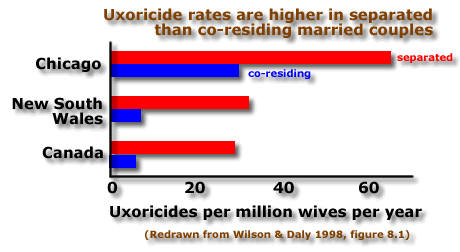 Examine
this figure from Wilson and Daly (1998). On the basis of this evidence,
what advice would you offer a battered wife contemplating leaving her
partner?
Examine
this figure from Wilson and Daly (1998). On the basis of this evidence,
what advice would you offer a battered wife contemplating leaving her
partner? - Explain, in evolutionary
terms, why undetected cuckoldry reduces male fitness.
- What are the limitations
associated with using undergraduates as participants in studies of
human sexuality?
- Wilson and Daly make
several predictions of 'risk factors' that may increase male sexual
violence:
- degree of local
competition between men for access to women;
- poor economic and
health prospects
- size of age cohort
- Do you think Wilson
& Daly would argue that school education programmes alone
would reduce male sexual proprietariness?
- Explain the term, and the
cultural, behavioural and physiological mechanisms involved in,
'mate-guarding'.
- What are the benefits of
marriage to men and women?
 This
figure is taken from Daly and Wilson
(1996) "Evolutionary psychology and marital conflict: the relevance of
stepchildren", available online. Are a woman's age, and the the presence of
stepchildren in the home risk factors for domestic violence?
This
figure is taken from Daly and Wilson
(1996) "Evolutionary psychology and marital conflict: the relevance of
stepchildren", available online. Are a woman's age, and the the presence of
stepchildren in the home risk factors for domestic violence?
Evolutionary
psychology and artificial insemination by donor
According
to evolutionary psychology some aspects of men's behaviour are directed
towards controlling female reproductive behaviour. For example, 'male
sexual proprietariness' is seen as part of an adaptation to reduce the
risk to male reproductive fitness posed by cuckoldry which reduces the
returns from paternal investment.
Artificial
insemination is one of the oldest and simplest treatments for human
infertility. There are two fundamentally different types of artificial insemination:
- In
artificial insemination with husband
sperm, the semen containing the sperm is obtained from the woman's male
partner.
- In
artificial insemination with donor sperm,
the semen containing the sperm is obtained from a volunteer who is not
known by the patient.
A man
who agrees that his partner be artificially inseminated with donor
sperm is agreeing to provide resources for a child that does not share
his genes. In contrast, a man who agrees that his partner be
artificially inseminated with his sperm
is agreeing to provide resources for a child that does share his genes.
Does this decision affect his behaviour towards his partner and child?
Evolutionary psychology would predict that couples who have children
through artificial insemination with husband
sperm would be less likely to experience family problems than couples
who have children through artificial insemination with donor
sperm.
Intrasexual
selection
Read
Daly and Wilson (2001).
"Risk-taking, Intrasexual Competition, and Homicide". Nebraska
Symposium on Motivation, 47:1-36. available online and
consider the following points:
- Explain
the meaning of the terms 'risk proneness / seeking', 'risk aversion'
and 'loss' in decision making research.
- Explain,
with examples, the conditions under which men might choose higher-risk
options. You should add to your answer as you proceed through the paper.
- Why
might a normally risk-averse animal switch to high risk behaviour?
- Explain
in your own words Daly and Wilson's comment that "...sex differences in
the variance of reproductive success are widely
considered indicative of sex differences in intrasexual
competition." my underlining (Daly and Wilson, 2001, p. 7-8)
- Make
brief notes to support the claim that men are polygynous.
- To
what extent are men less sensitive to risk than women ?
- What
is the relationship between gender, risk taking behaviour and status?
- If
risk taking is an adaptation, under what conditions would you expect a
man's attitude to risk to change as he gets older?
- Is
it legitimate to use homicide as a marker for male risk taking
behaviour?
- Is
male-on-male homicide simply the unfolding of a 'biological
predisposition' to violence in young men? Or is it an adaptation
sensitive to unconsciously perceived environmental conditions? If so,
what are these environmental conditions? You should add to your answer
as you proceed through the paper.
- Are
people's perceptions about future prospects 'rational' when viewed from
an evolutionary perspective?
- What
are the implications of Daly and Wilson's paper for social policy?
|


|
Building links between evolutionary psychology
and psychobiology
Psychobiology
is a broad term and somewhat loose term that groups together a wide
range of disciplines studied by psychologists and biologists.
Psychobiologists are interested in studying the biological bases of
behaviour. The term psychobiology covers a wide range of
sub-disciplines within psychology and biology including: physiological
psychology, psychopharmacology, developmental psychobiology, ethology,
neuroethology, animal behaviour, psychoneuroendocrinology, behavioural
and cognitive neuroscience, and psychoneuroimmunology.
Evolutionary
psychology focusses on why behaviours evolved in
particular ways.
For example, according to evolutionary psychologists, in species where
one sex makes a higher parental investment than the other - the high
investing sex - is a resource for which the opposite sex competes.
In the
next section we will examine some material that suggests that
psychobiology may be able to shed some light on sex differences in
risk-taking behaviours.
Aggression and sexual selection
In
humans, females make a higher parental investment
than do males. Males compete with each other for access to females.
Males use their dominance and resources to deter rivals and attract
females. Evolutionary psychologists argue that the higher rate of
aggression in men shows the crucial importance of status to male
reproductive success.
However
women can, and do show, aggressive behavious (see Campbell,
1999).
Females compete with each other, and men, for resources that will
enable them to successfully raise their children.
Sex differences in human
aggression
 |
Over
80% of homicides are committed by men.
Most of
the victims are also men. The most common cause of homicide is due to
the escalation of a relatively trivial disagreement over status that
starts with words and escalates into lethal violence. It seems that men
resort to violence to protect or gain status and honour.
This
sex difference is found across all cultures. Criminal violence is most
likely between the ages of 14 and 24. (see Campbell, 1999).
Some
psychologists have argued that boys are trained
to be aggressive and girls learn to be passive. However, Dyson-Hudson
(1995) found that: " 'low-conflict societies' with affectionate
socialization and aversion to inter-personal confrontation (e.g. Inuit,
!Kung Bushmen, Gebusi of lowland New Guinea) have high rates of violent
death. In contrast, Turkana pastoralists (East Africa) are taught to
fight as children; and most men reported having participated in inter-
personal fights intended to cause injury, having engaged in
recreational within-group fighting mimicking warfare, and having taken
part in raids on the neighboring Pokot. Yet demographic data indicate
that within- group homicide rates among the 'violent' Turkana are lower
than those reported for the 'low-conflict' societies.
It
may be that Turkana rules which require bystander intervention and
adjudication by elders, are effective in preventing within-group
aggression and violence from escalating into lethal fights. "
|
Male
aggression
 Richard Wrangham (Wright
and Wrangham, 1998) presents an interesting analysis of male violence
in terms of evolutionary psychology. He argues that:
Richard Wrangham (Wright
and Wrangham, 1998) presents an interesting analysis of male violence
in terms of evolutionary psychology. He argues that:
- Chimpanzees and
humans are the only species in which groups of males hunt and kill
members of their own species. In the Scientific
American Frontiers video (2001) "Chimps
Observed", Goodall describes her work, and discusses the
implications of lethal intraspecific aggression in chimps
- Therefore murder is not a
unique 'culturally determined' human
behaviour
- Chimpanzees patrol their
territorial borders in a group and will kill an isolated
animal from a neighbouring group. Under these circumstances there is little
risk that the aggressor will be seriously injured
whereas the victim will either be killed, or seriously harmed.
- Some forms of human
violence involve an accurate assessment of the risk of injury (e.g. the
Mafia are reputed to wait for a numerical advantage before they attack
their victim).
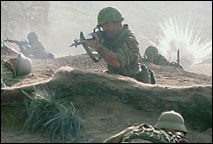 However warfare
is a uniquely human behaviour. In a battle both sides will
suffer casualties regardless of who finally wins. Consequently battles
involve a failure to assess the true costs of combat by both sides.
Wrangham suggests that this failure is due to 'positive
illusions' by each set of combatants that they will
emerge victorious
However warfare
is a uniquely human behaviour. In a battle both sides will
suffer casualties regardless of who finally wins. Consequently battles
involve a failure to assess the true costs of combat by both sides.
Wrangham suggests that this failure is due to 'positive
illusions' by each set of combatants that they will
emerge victorious
Female
aggression
Until recently, relatively little attention was
focussed on female aggression. Campbell (1999) argues that
".. lower rates of aggression by women reflect
not just the absence of masculine risk-taking but are part of a
positive female adaptation driven by the critical importance of the
mother's survival for her own reproductive success."

|
Campbell
reviews evidence that:
- women show
greater fear of physical harm compared to men.
For example:
- women show more
fear of open spaces, dogs, snakes, insects, and rodents than men
- women
are less likely to engage in hazardous sports, dangerous driving,
military combat, and drug abuse, than men
- women are more
afraid of being victims of crime involving aggression, and are more
likely to visit a doctor to seek advice on preventative care, than men
- women commit fewer
violent crimes than men (see Campbell et al, 2001)
- women show less
concern for status compared to men
- greater adoption of
dispute resolution strategies that involve a low risk of physical harm
by women compared to men
- female 'maternal
aggression' to defend their offspring; paternal aggression is rarer
- female menopause - an
infertile period after the birth of the last child will ensure its
survival
This is a picture of Phoolan Devi, (Seema Biswas)
so-called "Bandit Queen of India", she led a gang who roamed
north central India during the late 1970s and early 1980s; she became a
folk hero after taking bloody revenge against men who raped her.
|
These
stills are taken from the French film 'Baise Moi" which was banned in
several countries. The film deals with a young woman who has been
raped, and an accomplice, who embark on a spree of violence and
promiscuous sex. It is interesting to reflect on this film's treatment
by censors in the light of Campbell's argument that
"...Women's aggression
has been viewed as a gender-incongruent aberration or dismissed as
evidence of irrationality. These cultural interpretations have
"enhanced" evolutionarily based sex differences by a process of
imposition which stigmatises the expression of aggression by females
and causes women to offer exculpatory (rather than justificatory)
accounts of their own aggression."
|
 |
 |
Neurotransmitters
& Aggression
Serotonin and
aggression- animal studies
Increased serotonergic
activity tends to reduce aggressive behaviour in rodents.
- Isolation-induced,
resident-intruder and maternal aggression reduced by 5-HT agonist drugs
(agonists increase activity at neurotransmitter receptor sites )
- mutant
mice lacking the 5-HT 1B receptor gene show decreased attack latency,
and an increased number of attacks in the isolation-induced aggression
model (see Fig. 9.24 Feldman et al (1997)
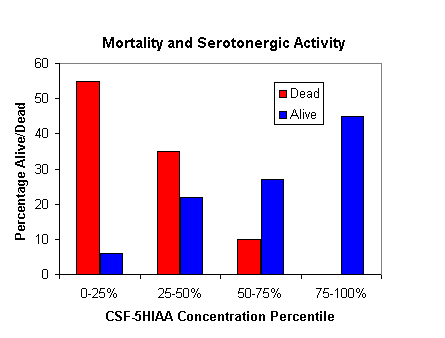
Adapted
from Fig 11.18 Carlson (1998)
|
Higley et al (1996)
studied free-ranging rhesus monkeys living on an island. Used
behavioural observations and sampled CSF (cerebro spinal fluid) to
measure 5-HIAA levels (5-HIAA is a breakdown product of 5-HT - the more
5-HIAA the greater 5-HT release).
- found
negative correlation between 5-HIAA and aggression. No relationship
between aggression and NA or DA metabolites.
- Low
5-HIAA associated with high risk-taking behaviour -aggression towards
older larger animals, took long leaps from tree to tree. Many died as a
result of attacks from mature males.
- low
5-HT turnover may reflect low impulse control rather
than increased aggression per se
|
"Dominance and
aggression are not synonymous." (Carlson,1998)
. Serotonin levels are
effected by dominance rank. Raleigh et al, (1984)
- 5-HT level is higher in
dominant than subordinate male vervet monkeys
- Removing
dominant male changes dominance hierarchy within remaining animals.
- New
dominant male shows increase in his 5-HT level.
- Restoring
previously dominant male provokes restores original 5-HT levels.
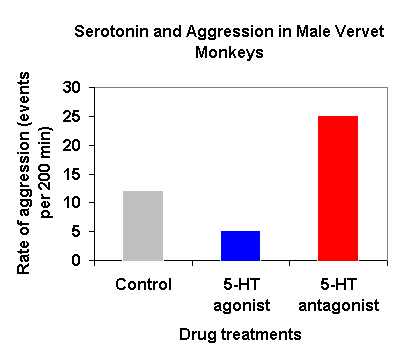
Redrawn
from Fig 9.25 Feldman (1997)
|
Raleigh et al (1991) investigated effects of serotonergic drugs on
dominance and aggression. Used 12 groups of vervet monkeys. Temporarily
removed dominant male from each group. The two remaining subordinate
monkeys were treated with
- serotonergic
drug
- control
(placebo)
The
serotonergic drugs used were
- 5-HT
agonists (tryptophan or fluoxetine)
which increase 5-HT activity
- 5-HT
antagonists (cyproheptadine or
fenfluramine) which decrease 5-HT activity (chronic treatment with
fenfluramine depletes 5-HT levels )
Used
a crossover design so that each monkey received
agonist and antagonist treatments.
Results:
- monkeys
given agonist drugs became dominant
- monkeys
given antagonist drugs became subordinate
- monkeys
given agonist drugs initiated fewer aggressive
events
- monkeys
given antagonist drugs initiated more aggressive
events
Note
that because a cross over design was used the same animal could be
dominant or subordinate depending on what type of serotinergic drug
they received.
|
Serotonin and human aggression
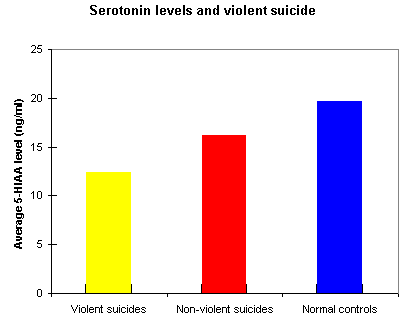 |
- Reduced
concentrations of 5-HT and 5-HIAA in brains of suicide victims.
- Maybe
suicide and violence towards other people represent the same underlying
aggressive tendency
- Low
5-HIAA levels in brains of suicides who used violent means to end their
own lives (using guns or jumping from heights rather than by ingesting
pills or taking a poison)
- in
normal adults there is a negative correlation between 5-HIAA level and
'urge to act out hostility' subscale of the Hostility and Direction of
Hostility Questionnaire
- in
psychiatric patients there is a negative correlation between 5-HIAA
level and psychological measures of aggression
- low
5-HIAA linked to impulsive, antisocial aggressiveness
- low
5-HIAA reported in children with disruptive behaviour
|
Author
Paul
Kenyon
References
and online resources
- Anon
(1998). "Sexual Selection and the Mind: A talk with Geoffrey Miller,
Edge, 41, May 26th 1998, available
online
- Akbar (2003) "Technological advances may
lead to genetic apartheid, says scientist". The Independent newspaper
4th March p 7
- Barrett, et al. (2002).
Human
Evolutionary Psychology , Palgrave.
- BBC
(2001). "Woman's Hour"- Mace and Segal debate evolutionary psychology's
approach to marriage and parenting. Broadcast on Wednesday 8
August 2001
- BBC
(2002). Human Instinct programme support materials: "More
Science About Lonely Hearts" available online
- BBC
(2003) Hitting Home - Domestic violence web site
- Buss
list of research papers available online
- Buss,
D. M. (1989). Sex differences in human mate preferences: Evolutionary
hypotheses tested in 37 cultures. Behavioral & Brain Sciences,
12, 1-49. available
online
- Buss,
D. M. (1995). "Psychological sex differences: Origins through sexual
selection". American Psychologist, 50, 164-168, available online
- Buss
(1996) "Sexual Conflict: Evolutionary Insights into Feminism and the
'Battle of the Sexes'", (In Buss and Malamuth "Sex, Power, Conflict:
Evolutionary and Feminist Perspectives", Oxford University Press),
- Buss, DM. (1999). Evolutionary
Psychology: The New Science of the Mind. Allyn and Bacon, Boston.
- Campbell
(1999). Staying alive: Evolution, culture and women's intra-sexual
aggression. Behavioural and Brain Sciences, 22, 203-252, available online
- Cheshire
Constabulary (ND) "Domestic violence" web page
- Chick
(1998) "What is Play For? sexual selection and the Evolution of Play"
Keynote address presented at the annual meeting of The Association for
the Study of Play, St. Petersburg, FL, February 1998, available online,
- Daly
and Wilson: list of research papers available online in pdf format
- Daly
and Wilson (1996) Evolutionary
psychology and marital conflict: the relevance of stepchildren.
Pp. 9-28 in DM Buss & N Malamuth, eds., Sex, power, conflict:
feminist and evolutionary perspectives. New York: Oxford University
Press.
- Daly
and Wilson (2001). "Risk-taking,
Intrasexual Competition, and Homicide". Nebraska Symposium on
Motivation, 47:1-36. available online
- Daly,
Wiseman, and Wilson (1997) "Women
with children sired by previous partners incur excess risk of
uxoricide". Homicide Studies 1: 61-71.
- Darwin (1859). Origin
of Species . Available online
- Darwin
(1871). The descent of man and selection in relation to sex,
available online GET URL
- Dyson-Hudson
(1995), Paper presented at the Human Behavior and Evolution Conference,
Santa Barbara, June 1995
- The Evolutionist
"In conversation with David Buss" available online
- Feldman et al, (1997).
Principles of Neuropsychopharmacology, Sinauer, Sunderland, MA., 1997
- Goodchild
(2003). "Lessons on viloence at home for 10-year-olds", The Independent
newspaper, 16th February, 2003 p. 13.
- Goodenough,
McGuire and Wallace (2001) Perspectives on Animal Behavior,
2nd Edition, Wiley, New York.
- Hewett
(2002) Theory of Sexual Selection: The Human Mind and the Peacock's
Tail online article
- Higley et al, (1996). Archives
of General Psychiatry , 53, 537-543.
- Kanazawa
(2000) Scientific discoveries as cultural displays: a further test of
Miller's courtship model. Evolution and Human Behavior, 21, 317-321,
2000. (Available from University of Plymouth, library offprints
collection)
- Keller
(2000). The Century of the Gene, Harvard University Press: Cambridge
Mass.
- Kenyon, Cronin and
Keeble (1983).Behavioral Neuroscience, 97, 255-269.
- Kruttschnitt,
C. (1994) Gender and interpersonal violence. In A. Reiss
and J. Roth (Eds.) Understanding and Preventing Violence
Volume 3. Washington DC: National Academy Press.
- Mace (2000). Evolutionary
ecology of human life history, Animal Behaviour ,
59, 1-10.
- Miller
(2000) "The Mating Mind: How Sexual Choice Shaped the Evolution of
Human Nature", Doubleday/Heinemann, a precis is available online
- Pawlowski,
Dunbar and Lipowicz (2000). Evolutionary fitness: Tall
men have more reproductive success. Nature 403, 156 (2000) abstract available online. Listen
to a radio interview in whch Dunbar
discusses this result.
- PBS
(2001) "Tale of the Peacock". Video featuring Petrie's work on
peacock tail feathers.
"Peahens often choose males for the quality of their trains -- the
quantity, size, and distribution of the colorful eyespots. Experiments
show that offspring of males with more eyespots are bigger at birth and
better at surviving in the wild than offspring of birds with fewer
eyespots."
- PBS
(2001) Evolution "Sex" video available online
- Raleigh et al,
(1984). Archives of General Psychiatry , 41,
405-410.
- Raleigh et al,
(1991). Brain Research , 559, 181-190 .
- Trivers
(1972). Parental investment and sexual selection. In Campbell (Ed).
Sexual selection and the descent of man:1971-1971 (pp136-179).
Chicago:Aldine.
- Thalheimer
and Cook ( 2001-2003,). "How to calculate effect sizes
from published research articles: A simplified methodology"
Work-Learning Research, Somerville, Massachusetts, USA, avalable online
- Wilson and
Daly (1998) Lethal
and nonlethal violence against wives and the evolutionary psychology of
male sexual proprietariness. Pp. 199-230, In RE Dobash
& RP Dobash, eds., Violence Against Women: International and
Cross-disciplinary Perspectives. Thousand Oaks CA: Sage.
- Wilson and Daly (1998a) Sexual
rivalry and sexual conflict: recurring themes in fatal conflicts.
Theoretical Criminology.vol. 2(3):291-310.
- Wright and
Wrangham, (1998) Morals, Demonic Males and Evolutionary
Psychology. In Information and Biological Revolutions: Global
Governance Challenges--Summary of a Study Group by Francis Fukuyama
Caroline S. Wagner. This project was conducted in RAND's Science and
Technology Policy Institute. Available online