A Psychological Research Methods and Critical Thinking Exercise
Author Paul Kenyon
|
|
"Does inclusive fitness theory
predict
grandparents' investment in their grandchildren?" A Psychological Research Methods and Critical Thinking Exercise Author Paul Kenyon |
Inclusive fitness: examples from everyday life
|
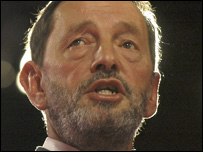
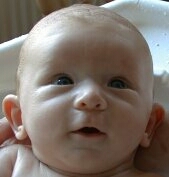
LIFE FOR BABY KILLER 27 November 2004 A
Whitleigh man who battered a six-month-old baby to death was today
beginning a life sentence for the killing. |
|
Evolutionary psychology holds that the human mind contains specialized modules that have evolved to increase inclusive fitness. Inclusive fitness refers to the propagation of genes into future generations, either directly by mating and caring for offspring, or indirectly by helping relatives (kin) survive and reproduce. Grandparents can increase their own inclusive fitness by helping their grandchildren survive and reproduce.
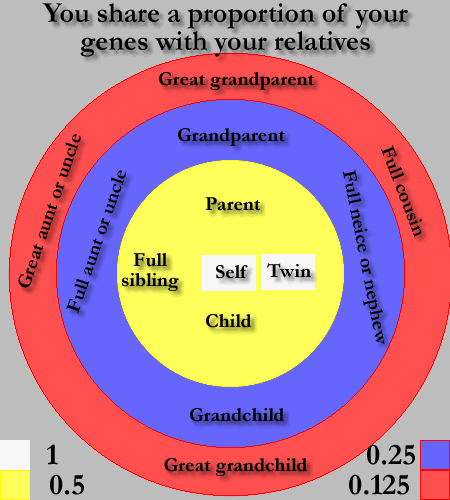
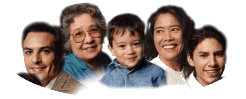 Identical twins share 100% of
their genes with each other. A parent shares 50% of their genes with
each of their children. A grandparent shares 25% of their genes with
each of their grandchildren. According to kin selection theory, parents
and grandparents will invest time and effort into children and
grandchildren.
Identical twins share 100% of
their genes with each other. A parent shares 50% of their genes with
each of their children. A grandparent shares 25% of their genes with
each of their grandchildren. According to kin selection theory, parents
and grandparents will invest time and effort into children and
grandchildren.
 |
Kin selection theory explains nepotism - the tendency to behave altruistically towards blood relatives - kin. Altruism involves a donor, a recipient, and a cost to the donor and benefit to the recipient. An altruistic act involves the donor giving something of benefit to the recipient that will enable them to survive and reproduce. According to kin selection theory, altruism increases as genetic relatedness increases. Hamilton (see Buss, pp223) formulated a rule to predict altruism between relatives. Basically Hamilton's rule predicts that we will favour close relatives over more distant ones for any given act of helping.
We all have four grandparents who can be classified as follows:
· Father's father - FaFa
· Father's mothers - FaMo
· Mother's father - MoFa
· Mother's mother - MoMo
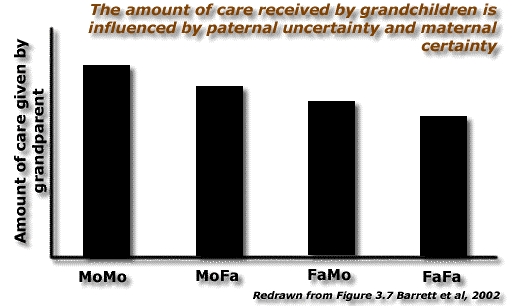
Euler and Weitzel (1996) found those grandparents on the father's side of the family (paternal grandparents - FaMo and FaFa) provided less care for their grandchildren than grandparents on the mother's side of the family (maternal grandparents - MoMo and MoFa).
 |
|
One explanation for this effect involves parental certainty. Women know with absolute certainty that they are the mothers of their own children (maternal certainty). On the other hand - because of the possibility of female infidelity - men can never be completely certain that they are the fathers of their children (paternal uncertainty).
In the case of a grandfather there are potentially two opportunities for the genetic link between himself and his grandchildren to become severed: · Because of female infidelity, the grandfather may not be the biological parent of his son or daughter · And - because of female infidelity - his son may not be the biological parent of his own children This is called the 'double whammy' effect.
On the other hand, grandmothers: · Are certain that they gave birth to their sons and daughters · Are certain that they are biologically related to their daughter's children · But - because of female infidelity - a grandmother may not be genetically related to her son's children
According to inclusive fitness theory the level of certainty in paternity should influence investment in grandchildren in the following way: MoMo - absolute certainty of paternity and thus certain of genetic relatedness - therefore this grandparent provides the most investment in grandchildren MoFa - generation effects may operate here (see below) FaMo - generation effects may operate here (see below) FaFa - greatest uncertainty of paternity and thus degree of genetic relatedness - thus this grandparent provides the least investment in grandchildren |
Generation effects refer to the possibility that grandparents may be sensitive to changes in rates of infidelity across generations in allocating their resources. Today's grandparents may believe that the rate of infidelity is greater in their children's generation than in their own generation. Thus FaMo may believe that her son is at greater risk of being the victim of his partner's infidelity than a man in her generation. In contrast, MoFa may believe that he was at less risk of infidelity and that therefore he really is the father of the grandchild's mother. Consequently MoFa is more certain of his genetic relatedness to his grandchildren whereas FaMo is relatively less certain of her genetic relatedness to her grandchildren.
The "Grandmother Hypothesis" refers to the possibility that menopause evolved as a way of investing in children and grandchildren (Barrett, Dunbar and Lycett, 2002, pp164-169; Hill & Hurtando, 1991)
Barrett,L., Dunbar, R. and Lycett,J. (2002). Human Evolutionary Psychology. Basingstoke: Palgrave.
Buss, D.M. (1999). Evolutionary Psychology: The New Science of the Mind (pp237-239). Boston, MA: Allyn and Bacon.
DeKay, W.T. (1995) cited in Buss, D.M. Evolutionary Psychology: The New Science of the Mind (pp237-239). Boston, MA: Allyn and Bacon.
Euler, H.A., & Weitzel, B. (1996). Discriminative grandparental solicitude as reproductive strategy. Human Nature, 7, 39-59.
Gaulin, S.J.C. McBurney, D., & Brakemann-Wartell, S. (1997). Matrilateral biases in the investment of aunts and uncles: A consequence and measure of paternity uncertainty. Human Nature, 8, 139-151.
Hill, K., & Hurtando, A.M. (1991) the evolution of premature reproductive senescence and menopause in human females. Human Nature, 2, 313-350.
Lancaster, J.B., & King, B.J. (1985). An evolutionary perspective on menopause. In J.K. Brown & V. Kern (Eds.) In her prime: A new view of middle-aged women (pp13-20). Boston, MA: Bergin & Carvey.
Slater, P.J.B. (1995) Kinship and altruism. In P.J.B. Slater and T.R. Halliday (Eds) Behaviour and Evolution (pp193-222). Cambridge: Cambridge University Press.
Smith, M.S. (1998). Research in developmental sociobiology: Parenting and family behavior. In K.B. MacDonald (Ed.), Sociobiological perspectives in human development (pp. 271-292). New York: Springer-Verlag.
Smith, P.K. Grandparents & grandchildren, The Psychologist, 18/11 684-687, 2005
Practical Psychological Research: Evolutionary Psychology
"Does inclusive fitness theory predict grandparents' investment in their grandchildren?"
1. Construct a brief that would ensure full informed consent from participants.
2. How would you explain the distinction between maternal and paternal grandparents to participants in this study?
3. Design a question which rank orders each grandparent in terms of the time they spent with the participant whilst they grew up,
and a question which rank orders each grandparent in terms of how emotionally close they were to the participant whilst they grew up.
4. How and why would you control for ‘order effects’ in the presentation of these questions?
| Workshop feedback - here are some ideas put forward by workshop participants. Are they good or bad ideas? | ||
| Q1: Construct a brief that would ensure full informed consent from participants | ||
| Good ideas | ?Good ideas? | ?Bad ideas? |
| "This study is investigating the closeness you feel to your grandparents" | "Study based on family relationships" - a bit too vague | "The study is a questionnaire on grandparents and grandchildren" - not fully informed. Brief should contain reference to emotional content i.e. your relationships |
| Q2: How would you explain the distinction between maternal and paternal grandparents to participants in the study? | ||
| Good ideas | ?Good ideas? | ?Bad ideas? |
| Ask them to give the name of each of their grandparents. Use this information to explain the terms 'maternal' and paternal'. | "Draw diagram i.e. family tree" - possibly confusing | "Maternal grandparents are the biological parents of your biological mother" - 'biological' may confuse |
| Q3. Design a question which rank orders each grandparent in terms of the time they spent with the participant whilst they grew up, and a question which rank orders each grandparent in terms of how emotionally close they were to the participant whilst they grew up. | ||
| Good ideas | ?Good ideas? | ?Bad ideas? |
| "Rank
order each grandparent in order of whom the most time has been spent.
1st being the most time and 4th the least time"
"Rank order each grandparent in order of with whom you feel most emotionally attached.. 1st being the most, 4th the least " This 'forced-choice' ranking is the procedure we will adopt |
Likert
scale with 1='very little time spent with grandparent' to 5="very
often".
OK, but end points of scale may mean different things and several grandparents may get same score - i.e. not forced to rank order grandparents. |
"How
close are you to both grandparents?"
Vague, what would you record to produce a number that could be statistically analysed? Does not distinguish between each of the 4 grandparents. "Who you have the most vivid memorys with as a child - good or bad?" Vague, what would you record to produce a number for each of the 4 grandparents that could be statistically analysed? |
| Q4. How and why would you control for ‘order effects’ in the presentation of these questions? | ||
| Good ideas | ?Good ideas? | ?Bad ideas? |
| "Have
half the participants be presented with Q1 first then Q2 and vice versa
for the other half"
"Change order of presentation of questions around, so the participants response is not biased" |
"control it by not having all the yes questions together" - this would control for 'response bias' not 'order effects' per se. | "Alternate
the rating or something every question" - this would not control for
order effects in question presentation.
"Ask more emotionally based questions last " - assumes you know which questions are emotionally charged. |
You can download the results (in an Excel spreadsheet) from the study carried out in December 2005. You can use this data to prepare histograms that address a number of specific questions.
Here is a series of questions, and examples of the histograms you can construct from data in the results file to seek answers to the questions. You should include a table of results and histograms in your report.
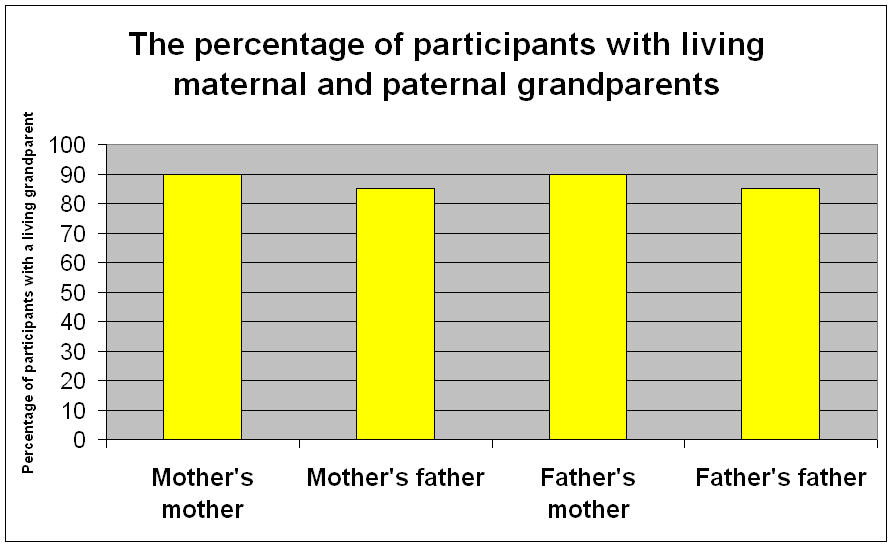
What percentage of participants have maternal and paternal grandparents alive today?
Are more grandmothers rather than grandfathers alive today? What is a likely explanation for this finding?
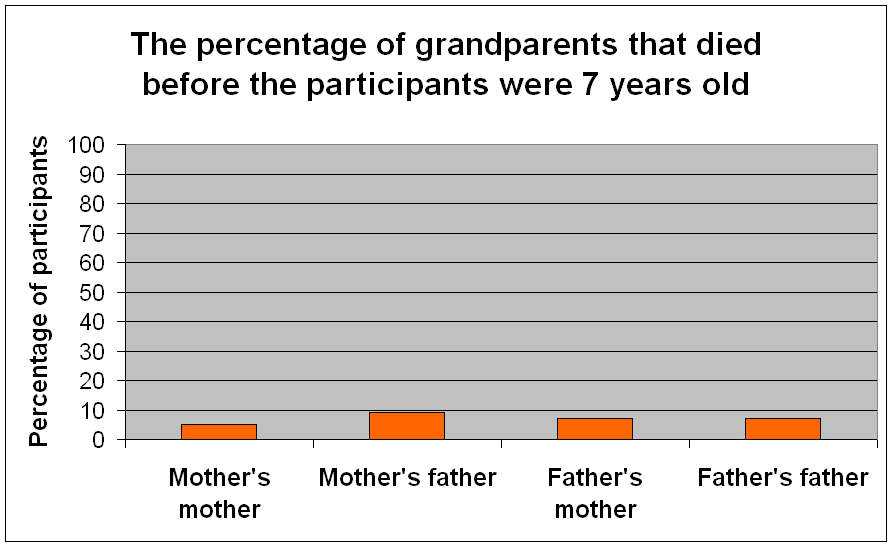
What percentage of grandparents died before the participants were seven years old? What is the impact of this pattern of results for the interpretation of our study?
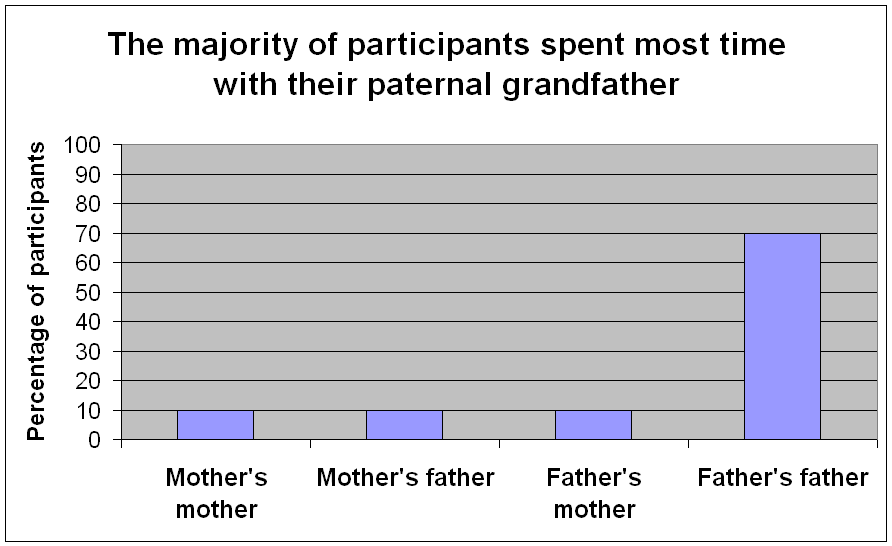
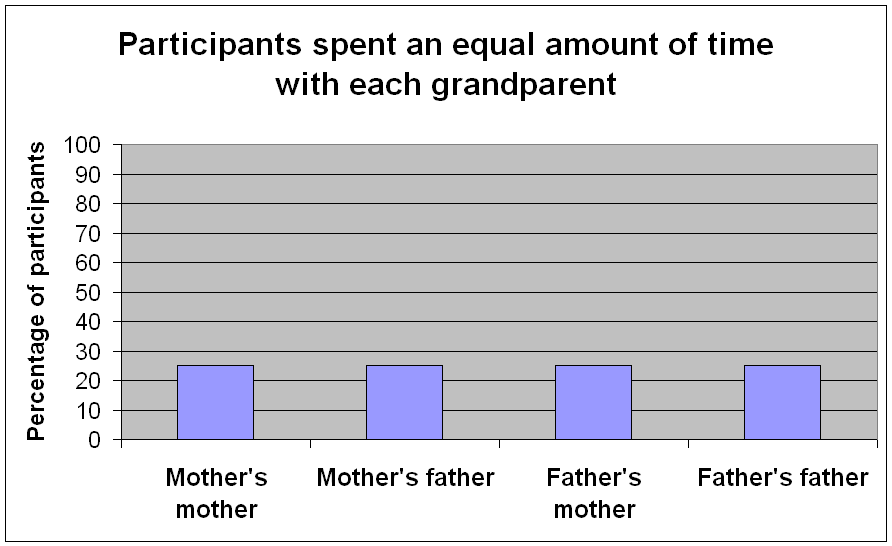
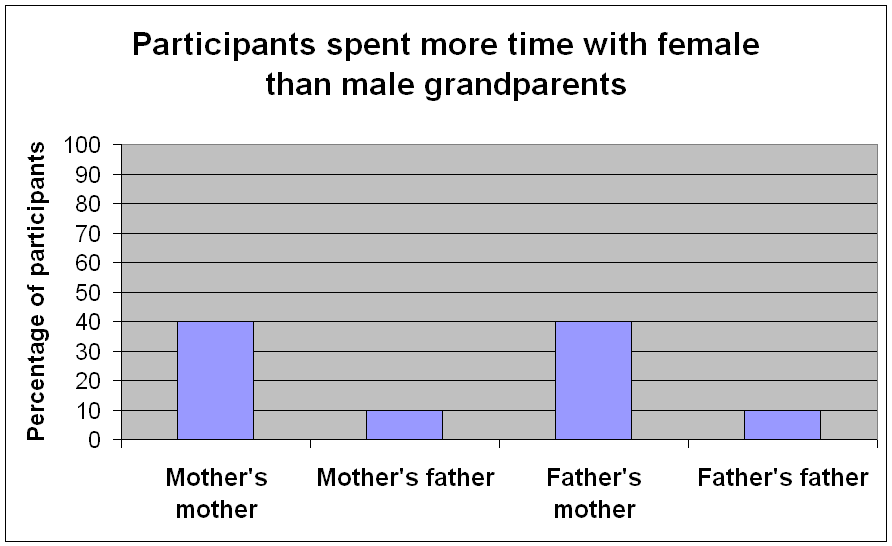
Which grandparent did most of the participants spend most time with when growing up?
There are several possible outcomes to our study:
participants may spend most time with their maternal grandmother when growing up, or
participants may spend most time with their paternal grandfather when growing up, or
participants may spend an equal amount of time with each grandparent when growing up, or
participants may spend more time with maternal than paternal grandparents
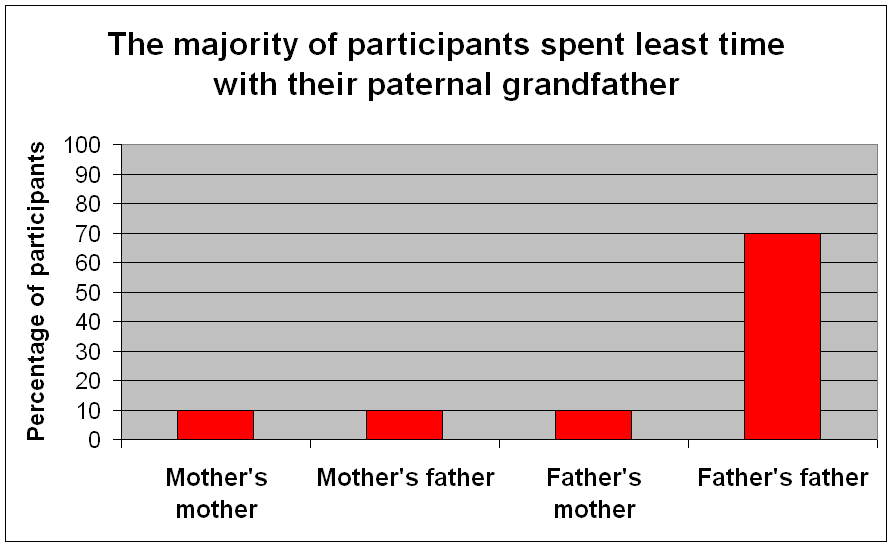
The following histograms illustrate each of these possibilities. You need to discuss if the pattern of results is consistent or inconsistent with inclusive fitness theory.

Which grandparent did most of the participants spend least time with when growing up?
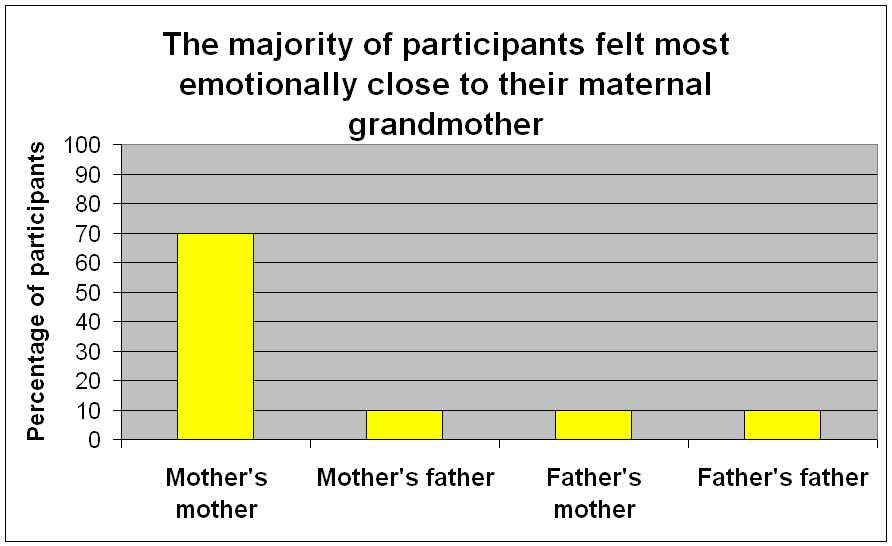
Which grandparent did the participants feel least emotionally close to when growing up?

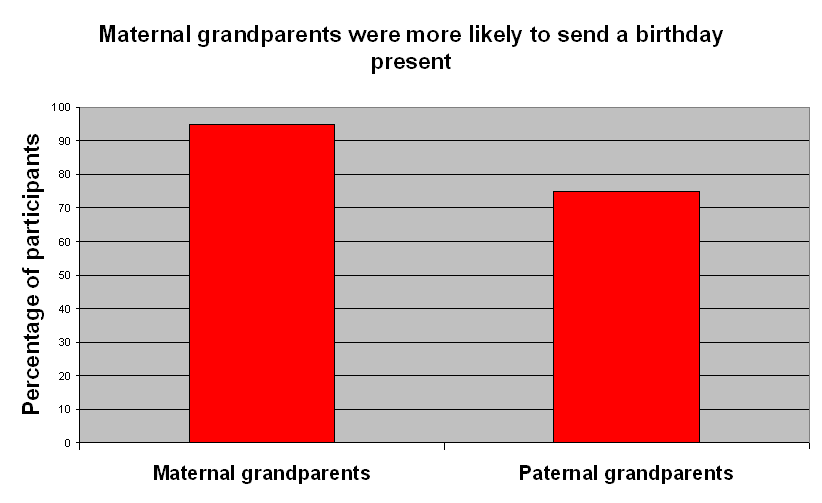
Did maternal and paternal grandparents send a birthday card?

Did maternal and paternal grandparents send a birthday present?
| |
|
|