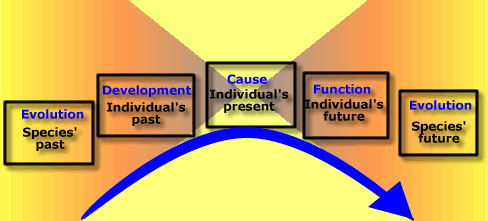
The following letter was published in The Independent on Saturday 11th January 2003 against a background of increasing concern about gun related crime in the UK:
"Earning respect"
 Sir:
Sir:
Blaming the rise of "gun culture" on popular music appears to be clutching at
straws. Rap music has a number of themes which can be traced to a desire for status and
respect. In the past such status was "earned" through the wearing of large gold
chains and driving around in prestige cars; now such icons compete with designer clothes,
expensive drugs and high-maintenance partners.
The need for "respect" continues but until men are measured by their character rather than what they possess, the "hard end" of acquisition culture will continue.
"The real solution is for women to value
honour, dedication and commitment rather than what they can acquire from men in the short
term. Only such pressure will change the behaviour of the young urban male. To encourage
women to look for personal qualities which make for a long-lasting relationship will also
go a long way to reducing the number of one-parent families and provide some sort of
future for our inner cities."
Robert Morley, Newquay, Cornwall.
You might comment on this letter by drawing from the literature on long and short term mating strategies in men and women, as well as the role of intrasexual selection and mate choice in sexual selection.
Other recent topics in the news include:
- traffic congestion in inner cities
- recycling domestic waste
How do these topics relate to psychological research into altruism and co-operative behaviour?
Genetic engineering, the human genome project and eugenics in the 21st century
The following section is based on a newspaper article by Connor (2003) "James Watson Nobel Prize Winner. Welcome to the Watson Wonderland: DNA genius still ruffles feathers 50 years after extraordinary discovery". The Independent, Monday 3rd February, 2003 , p 11.
In an interview to mark the 50th anniversary of his co-discovery of DNA with Francis Crick, the 75 year old Nobel prize-winner James Watson, who is now president of the prestigious Cold Spring Harbor Laboratory in New York, added to his reputation for holding outrageous and politically incorrect views by making the following comments on eugenics:
- "I always draw a laugh when I say that everyone knows the Irish need improvement:
- "You know, the only people who say that stupid people don't exist are people who are not stupid. We know that if we go to homeless people there is an underclass with a very strong mental disease component. Those people can't pull themselves together, the brain just won't allow it. So it is not that they are weak in character, they are seriously unequal."
- People in first-class universities may have brains that work more efficiently than people who aren't there and if you could help someone, wouldn't that be nice."
- "It's almost impossible to study the genetics of intelligence either in the US or the UK because it is socially contentious. You can say that the net effect is that it helps to perpetuate a system where people are dumb."
Connor notes that the study of genetics is fraught with difficulty because it is linked with the eugenics movement of the 1920s and 1930s that led Hitler's concentration camps. In response Watson argues:
- "Should Hitler harm us for the next 200 years by saying that we cannot do genetics? People say to me that 'you are acting like Hitler'. People have accused me of being a Nazi just because I won't accept raw evolution, because I wanted to filter it a little and try to improve the quality of life.... We can say that we want to improve human beings genetically but we don't want to do it by the ways that were attempted in the past."
- Referring to the Human Genome Project, Watson comments "The book of the DNA sequence would in time be regarded as more relevant to human life than the Bible. It tells us who we are, I've never read the Bible, so I'm not sure I've missed much."
You could comment on this article in the light of the impact of eugenics on the controversy generated by the rise of evolutionary psychology see Evolutionary Psychology under attack
Here are some examples of works of art that could be included in your portfolio of artifacts for comment.
| 'Imagine' by John Lennon
"Imagine there's no heaven, Written by: John Lennon |
 Edouard
Manet's painting Le Déjeuner sur l’herbe or Luncheon on the Grass Edouard
Manet's painting Le Déjeuner sur l’herbe or Luncheon on the Grass
This famous painting provoked criticism when it was exhibited in 1863 and seems to have defied explanation ever since. Can psychology shed any light on the meaning of this painting?
|
 Write a "Dear John" letter giving your
reactions to these lyrics by John Lennon from the perspective of any insights into human
behaviour provided by evolutionary psychology
Write a "Dear John" letter giving your
reactions to these lyrics by John Lennon from the perspective of any insights into human
behaviour provided by evolutionary psychology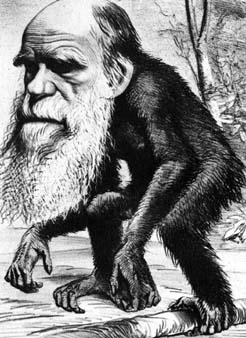 What does this cartoon of Darwin tell us about popular
views on the relationship between humans and other animals?
What does this cartoon of Darwin tell us about popular
views on the relationship between humans and other animals?