University of Plymouth
|


|
|
University of Plymouth
|
|
|
|
Carlson (Physiology of Behaviour, 6th edition, Allyn & Bacon, 1998) discusses the changing terminology used to describe the problems that can occur when people ingest psychoactive drugs.
He points out that the term ' addiction ' has been replaced by the term ' dependence '.
The WHO stress that drug dependence always includes ' a compulsion to take the drug on a continuous or periodic basis '
DSM-IV substitutes the word ' substance ' for ' drug ' and defines substance dependence as consisting of three of the following criteria within a twelve month period:
Carlson argues that the DSM-IV criteria omit an important aspect of drug addiction - its compulsive nature. You should read the appropriate section in Carlson's text and form your own opinion on whether recent redefinition has 'thrown the baby out with the bathwater' in this area.
Some definitions:
"an adaptive state that manifests itself by intense physical disturbance when the administration of drug is suspended "
"the drug produces a feeling of satisfaction and a psychic drive that requires periodic or continuous administration of the drug to produce pleasure or to avoid discomfort"
Eddy et al, 1965, (cited in Carlson, Physiology of Behavior, 6th Edition, p 563)
Tolerance refers to decreased sensitivity to a drug as a result of repeated exposure to the drug. Larger amounts of the drug must be administered to produce an effect. Caused by compensatory mechanisms that oppose the effects of the drug.
The effects of this compensation is seen as withdrawal symptoms which appear if the drug is discontinued.
Withdrawal symptoms are compensatory reactions that oppose the primary effects of the drug. Therefore they are the opposite of the effects of the drug.
For example with heroin:
| Effects of heroin | heroin withdrawal symptoms |
| euphoria | dysphoria |
| constipation | diarrhoea & cramps |
| relaxation | agitation |
The traditional interpretation of tolerance is that the drug triggers biological processes that reduce the drug's activity.
In behavioural tolerance the organism learns to decrease the effect of the drug on its behaviour.
Behavioural tolerance can involve:
You may have occasionally read newspaper reports of heroin addicts who have died as a result of heroin overdose. Some of these deaths may be the result of mixing heroin with other drugs, or a change in the addict's normal source of supply. But some deaths remain a mystery because addicts have died from doses that they tolerated the day before. They appear to have suffered from a sudden loss of tolerance . Siegel et al, ( Science , 216, 436-437, 1982) have argued that tolerance to heroin can be conditioned to the environment in which the drug is normally consumed. If the drug is taken in a new environment this conditioned tolerance will not protect the addict against a high dose of the drug - a dose that they would tolerate in their usual environment.
Seigel carried out an experiment in which rats were given heroin and a placebo injection under clearly different environmental conditions.
Injections of either heroin or placebo were given on alternate days for 30 days.
Then all the rats were given a very high dose (15 mg/kg) of heroin . But the room in which this potentially lethal dose of heroin was administered was varied between subgroups of rats.
This table shows the experimental treatments. The results of the experiment are discussed below.
| Day 1 | Day 2 | Day 3 | Day 4 | Day 5 | Day 6 | Day .. | Day .. | Day 29 | Day 30 | Heroin Overdose Test: 15 mg/kg heroin | |||||
| Group | Treatment | Colony room | Noisy room | Colony room | Noisy room | Colony room | Noisy room | Colony room | Noisy room | Colony room | Noisy room | Colony room | Noisy room | % mortality | Comment |
| 3A | Placebo | placebo | placebo | placebo | placebo | placebo | placebo | placebo | placebo | placebo | placebo | heroin | 96% | given heroin for first time | |
| 3B | Placebo | placebo | placebo | placebo | placebo | placebo | placebo | placebo | placebo | placebo | placebo | heroin | 96% | given heroin for first time | |
| 1B | Heroin in colony room | heroin | placebo | heroin | placebo | heroin | placebo | heroin | placebo | heroin | placebo | heroin | 64% | given heroin in novel room | |
| 2B | Heroin in noisy room | placebo | heroin | placebo | heroin | placebo | heroin | placebo | heroin | placebo | heroin | heroin | 64% | given heroin in novel room | |
| 1A | Heroin in colony room | heroin | placebo | heroin | placebo | heroin | placebo | heroin | placebo | heroin | placebo | heroin | 32% | given heroin in usual room | |
| 2A | Heroin in noisy room | placebo | heroin | placebo | heroin | placebo | heroin | placebo | heroin | placebo | heroin | heroin | 32% | given heroin in usual room | |
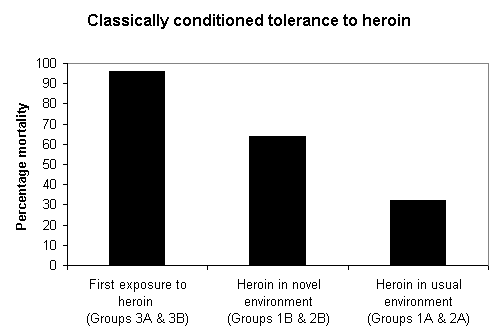
In the table the results for Group 3 are presented first - they show that the majority (96%) of rats die when they are injected with a large dose (15mg/kg) of heroin .
Fewer (64%) rats in Group 1B and 2B died, indicating that prior exposure to heroin leads to the development of tolerance which protects against a potentially lethal dose.
The death rate in Groups 1A and 2A was remarkably low; only 32% of these rats succumbed to the drug.
Here is a diagram of these results.
An important question is: Why is there a difference between rats in subgroups A and B?
All the rats in Groups 1 and 2 had received exactly the same pre-exposure to heroin.
The only difference between the groups with high and low mortality is the location of the heroin Overdose Test.
Siegel suggested that the reasons some addicts die from drug overdose is that they are like the rats in Groups 1B and 2B - they have taken their usual dose of drug in unusual circumstances. This account is borne out by addicts hospitalized for overdosing (Siegel et al, Science , 216, 436-437, 1982).
Siegel has proposed a classical conditioning model of drug tolerance:

I can remember being horrified by a friend who announced during a meal at a restaurant which involved the consumption of several bottles of very fine wine, that he intended driving home. He insisted that he was capable of driving. Some heavy drinkers even claim that they drive better when drunk. Thankfully good sense prevailed and we called a taxi.
The reason for this belief could be that heavy drinkers have had the chance to learn through operant conditioning to behave normally while intoxicated, whilst less experienced drinkers have not had this opportunity.
The next diagram shows the result of an experiment in which rats were trained to bar press for food on a DRL schedule (on a Differential Rate of Low responding schedule food is not delivered until the rat has failed to respond for a fixed length of time. For example, on a DRL 15 second schedule the rat must wait until at least 15 seconds have passed from the last reinforced bar press before a bar press will deliver the next food pellet).
When rats are injected with amphetamine their rate of bar pressing increases and consequently they will receive fewer reinforcements than saline injected animals. But the figure shows that eventually rats under amphetamine will learn to reduce bar pressing under amphetamine. This form of behavioural tolerance to the drug effect is thought to involve operant conditioning.

(Redrawn from Carey, Physiological Psychology, 1, 9-12, 1973)
But of course on its own this set of results does not rule out the possibility that some other form of tolerance is at work here. For example, you could explain these results in terms of biological tolerance
However this explanation appears less likely in view of Carey's observation that motor activity did not become tolerant to the effects of amphetamine.

If the tolerance exhibited by rats working on the DRL schedule was due to some biological process we would predict that tolerance would also develop to the effects of the drug on motor activity. Clearly this is not the case. One explanation for the different effects of amphetamine on DRL performance and motor activity is that tolerance to a drug only occurs when the drug causes a reduction in reinforcement density.
This hypothesis can be tested using the B-A procedure . This procedure involves two groups of animals: B and A.
Consequently both groups will have had exactly the same exposure to the drug.
If tolerance is simply a matter of drug exposure, the behaviour both groups should be identical when the are given the drug before the final test session.
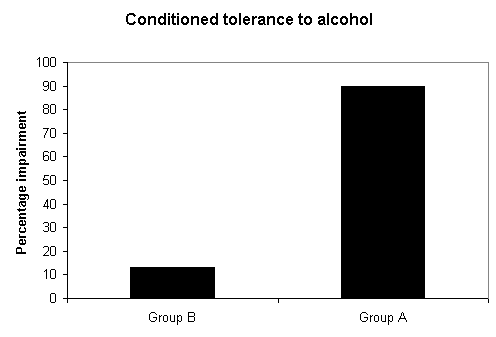
Chen ( Psychopharma cologia ( Berlin ), 12, 433-440, 1968) developed the B-A procedure to study the effect of alcohol on maze performance in rats (echoes of my drink-driving friend!). Rats were trained to traverse the maze, and when their performance was reliable they were randomly allocated to one of two groups:
Before the final test session both groups received an alcohol injection.
| Session 1 | Session 2 | Session 3 | Test Session 4 | Impairment on Session 4 | |
| Group B alcohol injected: | before session | before session | before session | before session | 13% |
| Group A alcohol injected: | after session | after session | after session | before session | 90% |
This next figure shows the degree of disruption caused by alcohol in each group. If alcohol tolerance was simply a biological process we would there to be no difference between the groups. But clearly rats in Group A were more effected by the injection than those in Group B which supports the hypothesis that behavioural tolerance to alcohol developed in Group B.