University of Plymouth Department of Psychology

Schizophrenia 2:
PSY335/206 Physiological Psychology Lecture Support Material


Here is a Table of Contents

Lecture overview

Dopamine receptor subtypes and schizophrenia


Dopamine neurotransmission

Dopamine neurotransmission

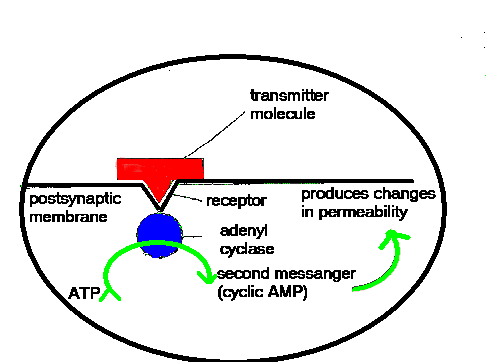
Dopamine activates receptors in the postsynaptic membrane to release adenyl cyclase

Dopamine (red) activates the receptor to release (blue) an enzyme (adenyl cyclase) which converts ATP into cyclic AMP (cAMP).
cAMP initiates a series of chemical reactions that alter the membrane's permeability.
 Dopamine and adenyl cyclase

Antipsychotics & cAMP

Poor correlation (shown as the red line in the diagram) between inhibition of DA sensitive adenylate cyclase and clinical potency.
Note especially that butyrophenones ( Haloperidol, Pimozide and Spiroperidol ) are very potent drugs clinically but they are not very potent in their ability to inhibit adenylate cyclase. Antipsychotics and cAMP

DA receptor types

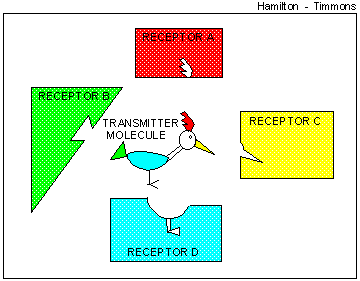
Here is a really nice diagram explaining the concept 'receptor' from Hamilton & Timmons online book Drugs, Brains and Behavior
receptor concept
After storage in the presynaptic neuron, dopamine is released into the synaptic cleft, where it may bind to an autoreceptor and thus inhibit the release of more dopamine. However, it may instead bind to a D1 receptor associated with adenylate cyclase, or to a D2 receptor. DA receptor types

Antipsychotics bind to D2 receptors


Antipsychotics bind to D2 receptors

D2 receptor binding & clinical potency

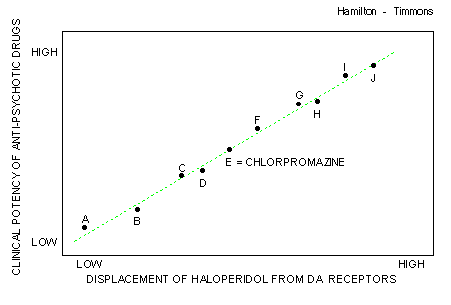
There is a high correlation (r=0.87) between the affinities of antipsychotic drugs for the D2 receptor site (as measured by interference with the binding of radiolabelled haloperidol) and clinical potency ( as measured by the amount of the drug that needs to be given to schizophrenic patients). From Hamilton & Timmons online book Drugs, Brains and Behavior- well worth a visit.
D2 receptor binding and clinical potency

D1 & D2 receptors in schizophrenia

There are significantly more D2 receptors in the brains of deceased schizophrenics than in nonschizophrenic controls.
There is no significant difference in the number of D1 receptors in schizophrenic and control brains.
D1 and D2 receptors in schizophrenic brain

Supplementary material

I strongly recommend the chapter Schizophrenia as a model of dopamine dysfunction in Hamilton & Timmons online book Drugs, Brains and Behavior
For simplicity in my lecture, I only discuss two dopamine receptors. This is intentional. But you should be aware that there are more than two recptor types. This page by James H. Meador-Woodruff, M.D. has images which summarize the distributions of five dopamine receptors found in normal human brain.

Please send me your feedback

What did you think of this learning resource? (e.g. loading speed, organisation, detail & clarity of information)
Please type your comments here:

If you find any other useful information that could be included here please send me the URL via email to Paul Kenyon Return to Biological Bases of Behaviour Home page