Welcome to SALMON the 1998 UCISA award winning website developed by Dr Paul Kenyon (retired) to support students studying evolutionary psychology and behavioral neuroscience in the Department of Psychology, University of Plymouth, Devon, UK
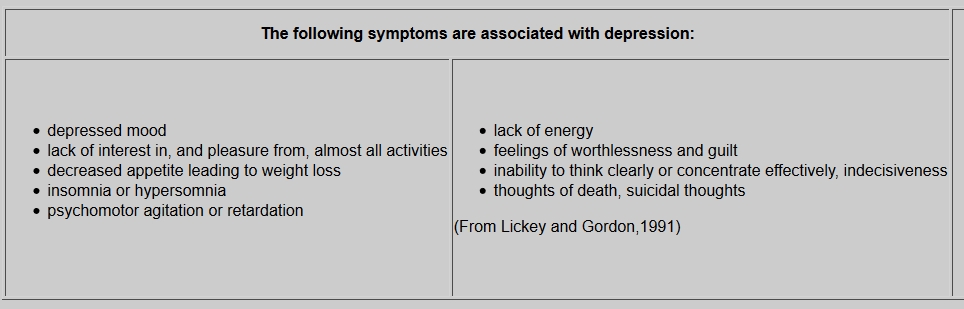
This web page explores the Learned Helplessness theory of depression developed by Martin Seligman in the 1970s. It begins by outlining the symptoms that any theory of depression must account for. The phenomenon of learned helplessness is then introduced, and Seligman's novel idea of uncontrollability is explored. The central axiom of the theory - that helplessness is a cognitive state in humans and animals is emphasized, before comparing helplessness in animals with human depression.
The Motor Activation Deficit hypothesis represents a major challenge to Learned Helplessness theory. An experiment by Weiss that pits the two explanations against each other is described. The results suggest that helplessness may be the result of a temporary deficit in a neurochemical system involved in learning.
This topic is included in your course because it illustrates how a theory - not only serves to bring together a body of existing knowledge - but also acts as a catalyst for further research. After exploring this material - and studying the recommended reading - you should form your own opinion on the following questions:
There are a number of less straightforward issues that you may care to think about as you study this material.
Many people experience sadness following major trauma such as death in the family, divorce or job loss. This is not depression. Depression resembles sadness, but it is more severe and intense. In addition, whereas there is usually a reason for sadness, it can be difficult to account for the severity and intensity of depression in the light of the life events experienced by the sufferer.
Martin Seligman is responsible for the Learned Helplessness theory which had a major influence on psychological research into depression in the 1970s. Seligman discovered helplessness by accident whilst studying the effects of inescapable shock on active avoidance learning in dogs.
Seligman restrained dogs in a pavlovian harness and administered several shocks (UCS) paired with a conditioned stimulus (CS) - this is the conventional CS-UCS pairing procedure used to study classical conditioning . Then these dogs were placed in a shuttle-box where they could avoid shock by jumping over a barrier. The shuttle-box was used to study the role of operant conditioning in learning. Most of the dogs failed to learn to avoid shock.
Seligman argued that prior exposure to inescapable shock interfered with the ability to learn in a situation where avoidance or escape was possible. Seligman used the term Learned Helplessness to describe this phenomenon.
It is important to emphasize that helplessness is > not an all-or-none phenomenon. Seligman studied the behaviour of about 150 dogs between 1965 and 1969. About 100 (2/3rds) were helpless after the administration of unavoidable electric shock in the pavlovian situation. The remaining 1/3rd were completely normal and learned to avoid shock in the avoidance learning test. There was no intermediate outcome - dogs either learnt to avoid, or passively accepted shock in the shuttle-box. Furthermore, about 5% of naive dogs that had never received inescapable shock, exhibited helplessness when first exposed to shock in the operant learning situation.
The central idea in the Learned Helplessness theory is the notion that all animals (including humans) are able to learn that reinforcers are > uncontrollable . This marks a sharp change in direction from previous studies of learning which had focussed on learning in controllable situations (Seligman,1992).
This diagram shows the location of various schedules of reinforcement within the response contingency space. The x axis (horizontal) shows the probability of an outcome (e.g. delivery of food, escape from shock) when a response is made.
The y axis (vertical) shows the probability of an outcome (e.g. delivery of food, escape from shock) when a response is NOT made
The red line shows uncontrollability .
It is important to appreciate that although cognition is at the heart of Seligman's theory, learned helplessness affects other psychological processes:
Seligman argues that there are similarities between the symptoms of depression in humans and helplessness
This concludes my very brief introduction to Learned Helplessness. I have had to omit many important ramifications of the theory, in particular predictions from the theory about the causes of depression and how it could be treated. Seligman goes into these topics in his very readable book: Seligman,M.E.P., > Helplessness , Freeman, New York, 1992.
I want to focus on one aspect of helplessness and depression that has posed problems for Seligman's theory: the physiological basis of Learned Helplessness. Seligman points out similarities between the physiological basis of depression and helplessness:
Physiology of depression |
Physiology of learned helplessness |
| Depression is associated with a deficiency of catecholamines
(particularly norepinephrine) at central receptor sites. This is the catecholamine theory of mood |
Helpless rats have lowered levels of norepinephrine in the brain |
Weiss believes that 'learned helplessness' is produced by "some form of stress-induced 'debilitation'". He called this the Motor Activation Deficit hypothesis (Weiss & Glazer, Psychosomatic Medicine, 37, p501, 1975). He highlights one important observation made by Overmier and Seligman in their original report of learned helplessness:
"They reported that poor avoidance-escape performance in the dogs was evident 24 hr after the session of inescapable shock but was totally absent if the dogs were first tested 48 hr after shock ."
(Weiss & Glazer, Psychosomatic Medicine, 37, p501, 1975, emphasis added)
Weiss has studied the effects of exposure to uncontrollable situations on norepinephrine (NE) metabolism in the brain (e.g. Weiss, J.M. et al, Psychosomatic Medicine, 37, 522-533, 1975).
Weiss argues that rapid dissipation of the learned helplessness effect is not characteristic of learning, but instead indicates a short-term physiological imbalance that corrects itself with the passage of time from exposure to trauma.
In support of this argument the diagram shows that NE level in the brain is:
This suggests that the reason Seligman's dogs did not exhibit helplessness when tested 48 hr after uncontrollable shock was because brain NE had returned to normal by this time.
However, the effects of shock on brain chemistry depend upon prior experience.
Previous research has revealed that NE levels are not depleted if animals are given repeated exposure to uncontrollable shock.
Weiss used this information to design a clever experiment to test the two competing explanations of helplessness.
Rats were given repeated exposure to uncontrollable shock before being tested for their ability to learn an avoidance response in a shuttle-box.
This table is a simplified version of the treatments given to separate groups of rats in the experiment :
The results of Weiss & Glazers' experiment (Psychosomatic Medicine, 37, 523-534, 1975) together with the predictions made by the two theories are shown below in an interactive table that allows you to separately view the results of each experimental treatment. Click on the group names (S-S, NS-S, and NS-NS) to view the results for each independent group in the experiment. Compare each groups actual performance with the predictions made by the two theories.
In the late 1970s, Seligman's theory of depression was reformulated within the framework of attribution theory (Gilbert, 1984). Briefly depression will occur if:
This Wikipediapage has a useful discussion of "attributional reformulation" of learned helplessness
