University of Plymouth
Department of Psychology

Study And Learning Materials ON-line

Overview:
Newborn rat pups appear helpless little pink bundles of potential behaviour. Don't be fooled, they are already behaving their little heads off! You may think they are "helpless passive recipients of maternal care", but they are from it. They are engaged in an intricate behavioural dance with their parents for survival. Newborn pups play an active role in eliciting maternal behaviour from their mothers. In this lecture we will explore some of the factors that control this reciprocal partnership. Rat mothers are attracted by the sight, sound and odour of their pups. Pups utilise perioral sensations to locate and suckle from their mother's nipples. The lecture concludes with a model put forward by Carlson that suggests how estrogen interacts with brain regions involved in maternal behaviours. You should link this model with the material we covered on hormonal regulation of maternal behaviour

Lecture outline

Sensory & neural control of maternal behaviour

What's that awful smell!

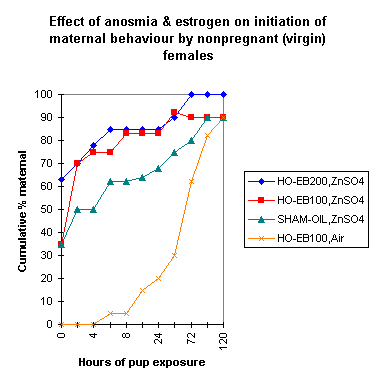
Initiation of maternal behaviour by nonpregnant (virgin) females following Hysterectomy+Ovariectomy (HO) + estrogen treatment and/or olfactory-vomeronasal deafferentation by intranasal zinc sulphate (ZnSO4) which renders the rats anosmic - unable to smell. Females were exposed to groups of 4 pups, 3-8 days of age, during the dark phase of the daily 12:12 hr cycle. Females were considered to have initiated maternal behaviour when they retrieved all test pups during 2 tests one day apart.

Treatment designations:


anosmia and maternal behaviour

Perioral sensation and retrieving

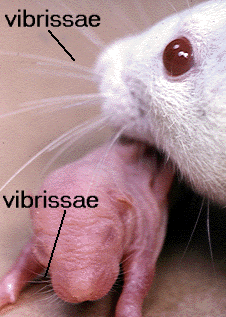
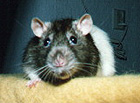
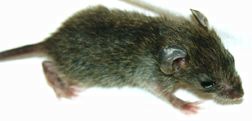
location of vibrissae This photograph shows the location of the vibrissae in adult rats and pups.

You can see from this photograph just how delicate the mother's retrieving behaviour must be in order to prevent damageing the pup's skin.

Tactile cues are very important in controlling a number of rat behaviours. Sensation from the region around the mouth (the perioral area) can be abolished by injecting a local anaesthetic into the mystacial (vibrissal) pads.

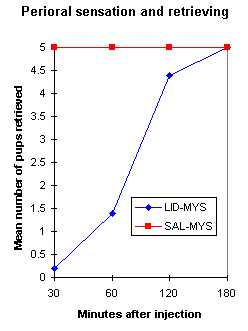
anapsis and maternal behaviour This diagram shows the results of an experiment that examined the role of perioral sensation in maternal behaviour.

Mean number of pups retrieved by mothers injected with lidocaine (LID-MYS) or saline (SAL-MYS) in the mystacial pads on tests given 30, 60, 120 and 180 min after treatment.


From Kenyon CAP, Cronin P and Keeble S, (1983) Role of the infraorbital nerve in retrieving behaviour in lactating rats. Behavioral Neuroscience , 97 , 255-269.

Perioral sensation and suckling


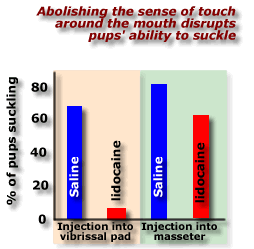
anapsis and suckling
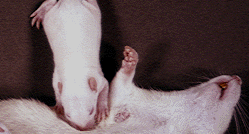
Rat pups utilise perioral sensation to locate and attach to their mothers nipples.

This diagram shows the percentage of pups attaching to the nipples of an anaesthetized dam after injection of saline (SVP) or lidocaine (LVP) into the vibrissal pads, or saline (SM) or lidocaine (LM) into the region of the masseter muscle.

From Kenyon CAP, Keeble S and Cronin P, (1982) The role of perioral sensation in nipple attachment by weanling rat pups. Developmental Psychobiology, 15, 409-421.

Point to ponder
What control experients would you run to ensure these results were caused by a lack of perioral sensation (anapsis)?

A proposed model of sensory regulation of maternal behaviour in the female rat.


"Stern suggests that both distal and proximal cues interact to produce the entire complement of maternal behaviour. Distal cues (the sight, sound and odour of pups) attract the mother to them and arouse contact seeking behaviour. These behaviours lead to perioral contact, which triggers nuzzling, licking and hovering. The proximity of the mother leads the pups to root against her ventral surface, which stimulates a crouching posture that presents her nipples to them." Carlson, p326.

Mother

Pups

Distal cues stimulate mother to seek contact with pups Pups provide distal cues: sight, sound, and smell for the mother
Perioral contact stimulates the mother to nuzzle, lick and hover over pups The mother makes perioral contact with pups
Pups making venral contact with the mother stimulates her to adopt the crouching posture The pups nuzzle the mother's ventral surface. The crouching posture facilitates the pups' suckling behaviour

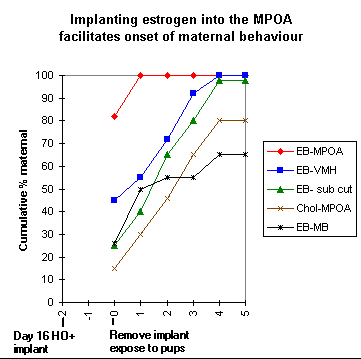
Central implants

Cumulative percentage of 16 day pregnant hysterectomised (H) and ovariectomised (O) female rats showing maternal behaviour over the five day test period. Abbreviations:
estrogen implants in MPOA location of MPOA

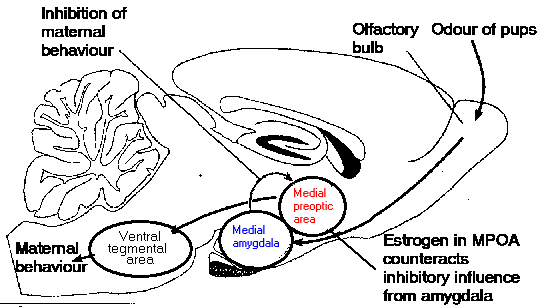
Carlson's model of hormone effects on maternal behaviour

A possible explanation of the facilitating effects of estradiol on maternal behaviour. Olfactory information travels directly to the olfactory bulbs, then to the medial nuclei of the amygdala via the lateral olfactory tract. Cutting the nerves illustrated in the model facilitate the onset of MB, presumably by blocking the transmission of aversive olfactory information. See Carlson, Physiology of Behavior, p329.
Carlson's model of hormone effects on maternal behaviour
Here are the components of Carlson's model highlighted on a sagittal section of the rat brain.
location of components

Supplementary material

There are some impressive sets of vibrissae out there! As you may have realised during the lecture I am very interested in the role played by vibrissae in controlling various aspects of rat behaviour. Here are some sources of further information. It is worth looking at some of these links to get a feel for how study of an apparently esoteric sensory system in the rat may lead to fundamental breakthroughs in our understanding of the relationship between brain and behaviour.
  • Thomas A. Woolsey of Washington University provides an elegant and short explanation of how studying vibrissae can enhance our understanding of the structure, function and development of the central nervous system.
  • Victor Pegado of McMaster University has published a diagram showing that a very large area of rat brain is devoted to processing vibrissal information. His site also contains pictures of the barrel fields in the somatosensory cortex of a rat. One of the reasons people are interested in vibrissae is that it is possible to trace structures running from the vibrissae all the up through the brain to the cortex that are responsible for processing information from each single vibrissae. For example, if a single vibrissae is removed in a very young rat there is a corresponding 'hole' in the somatosensory cortex.
  • Dr. Brad Klein in the Dept. of Biomedical Sciences and Pathobiology at the Virginia-Maryland Regional College of Veterinary Medicine at Virginia Tech is researching the function of the the trigeminal system.
  • Heinz Steiner at The University of Tennessee, Memphis uses the trigeminal system (which transmits vibrissal information) to study neuroplasticity.
  • Barry D. Waterhouse of Temple University uses the vibrissal system in his quest to understand norepinephrine and serotonin regulate the responsiveness of sensory neurons and sensory circuits to synaptic inputs.
  • This paper Rat exploratory behavior following infraorbital deafferentation or selective cerebellar lesions by Michael Lin, Josée Morissette, Mitra J. Hartmann, and James M. Bower reports no significant effect of cutting the trigeminal nerve on exploratory behaviour. Can you think of an explanation for this lack of effect?
  • Moore, Sur and Nelson working at MIT report their study of sensory responses from neurons in rat somatosensory cortex.
  • All you ever wanted to know about Somatic Sensory Cortical Regions of the Agouti

Please send me your feedback

What did you think of this learning resource? (e.g. loading speed, organisation, detail & clarity of information)
Please type your comments here:


If you find any other useful information that could be included here please send me the URL via email to Paul Kenyon
Return to Biological Bases of Behaviour Home page