PSY128 Lecture Support Material: Hormones & Sexual Behaviour

Overview: A quick glance at the title might lead you to believe that this is going to be a very interesting lecture. Well it is interesting, but not in the way you think! You will see how the role of hormones in behaviour has been elucidated by removing the endocrine glands, observing the animals behaviour and then replacing hormones to reverse the effects of the original intervention. This is a fundamental scientific strategy (remove - observe - replace - observe) and crops up in many behavioural experiments. A very important question is: Do the effects of these hormone manipulations reflect an effect of hormones on the animal's brain, or are the effects secondary to changes in peripheral tissues? It would be nice to believe that we were observing central effects - after all we are principally interested in the brain. But the possibility that the animal's behaviour is affected by more mundane peripheral effects needs to be experimentally verified. Studies which address this issue are described.
Here ia aTable of Contents
Learning objectives
  • recognize the location of endocrine glands producing gonadal steroids
  • describe the sexual behaviour of female rats
  • operationally distinguish between receptivity, proceptivity and attractiveness
  • describe the sexual behaviour of male rats
  • list 4 measures of male rat sexual performance
  • distinguish between time limited, series limited and satiation tests of sexual behaviour
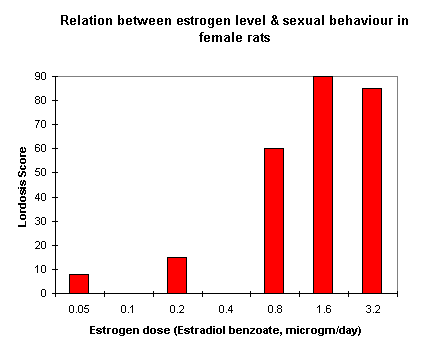
  • draw a diagram to illustrate the effects of estrogen injection dose on sexual behaviour in female adult rats
  • describe the effect of ovariectomy & estrogen replacement on rat uterine weight
  • describe the effects of castration on sexual behaviour of male rodents
  • describe the effect of castration and testosterone replacement on seminal vesicle weight and papillae of glans penis in male rats
  • explain the importance of studies involving central injection of hormones 

Frank Beach

Frank Beach
Frank Beach is generally considered to be the founding father of the study of the effects of hormones on behaviour - an area of scientific investigation that is known today as behavioural endocrinology or psychoendocrinology. His first book, Hormones and Behavior (1948), summarizes all that was known at the time and organized the field for all subsequent investigators. Beach devoted his whole life to basic research and justified his endeavors as follows:
To what degree should my choice of research work be governed by human needs, by social imperatives, and how am I going to justify spending all of my energies on any research that does not bear directly on pressing human problems.... The solution, or rationalization, that I have finally come up with is that it is a perfectly worthwhile way of spending one's life to do your level best to increase human knowledge, and it is not necessary nor is it always even desirable to be constrained by possible applicability of what you find to immediate problems. This may sound very peculiar to some young people, but it is a value judgment which I myself have made and which I can live with.
As you probably realize, Frank Beach is my hero, and I have spent a large part of my research career following up his fascinating work on the role of sensory systems in controlling reproductive behaviors.
Point to ponder
Why are you interested in the study of behaviour?
Do you think it would be possible to pursue a research career in the 1990s along the lines followed by Beach?
What do you think is the general publics' perception of science today, and why?

Sexual behaviour in the female rat: lordosis

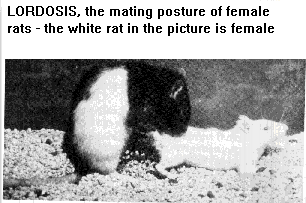
At one time it was thought that the mammalian female was a 'passive recipient' in copulation. Many early studies measured female sexual behaviour in terms of a 'lordosis score'. Lordosis refers to a characteristic posture in which the female rodent arches her back and moves her tail to permit penetration by the male. But in fact the female rat often plays a very active role in initiating copulation. If she is in estrus and sexually receptive she will
Points to ponder
Why do you think - at one time - female rats were viewed as passive recipients of male sexual sexual behaviour? What does this tell us about the effect of the influence of researchers' attitudes and values? Can you think of other examples of this effect?
 Not all of these behaviors are shown by all rats in estrus. There are individual differences in the intensity of these behaviors that may be linked to variation in circulating hormone levels.
lordosis

Sexual behaviour in the male rat

Sexual behaviour in male rats consists of three behaviors: It can be very difficult, even for a trained observer, to distinguish between these behaviors. Mounts and intromissions are particularly difficult to distinguish.
Typically rats have multiple ejaculations before they are satiated. Each ejaculation is preceded by a number of mounts and intromissions. Sexual encounters are divided into a number of 'series' depending upon the number of ejaculations. A series starts with a mount or intromission and ends with an ejaculation.
Numerous measures of the relationships between mounts, intromissions and ejaculations are recorded to measure sexual motivation and performance. For example:


This list of behavioural measures is by no means exhaustive.
Tests of sexual behaviour are either:
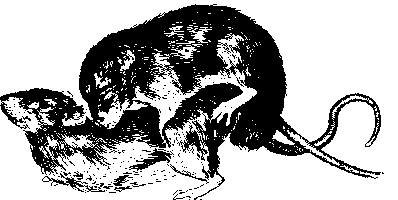
rat sex behaviour, male mount

Effects of estrogen on sexual behaviour in female adult rats

Effects of estrogen on sexual behaviour in female adult rats
In the experiment shown above (Davidson et al, 1968) adult female rats with ovaries removed (ovariectomy) were given daily injections of estradiol benzoate; 5 groups each received a different dose over a 12 day period. On days 8, 10 and 12 each rat was given about 10 test trials with a sexually active male. The behavioural measure was the lordosis score, that is, the percentage of trials on which the female showed a lordosis response when the male attempted to mount. Scores are mean performance over the three test days. Note that each point on the scale of dosages indicates twice the preceding value.
In this early experiment only one aspect of female sexual behaviour was explored. In fact hormones have three effects on female sexual behaviour. They affect:
Point to ponder
How would you measure the effect(s) of hormones on human sexual behaviour?

Effect of estrogen on growth of rat uterus

How might estrogen affect sexual behaviour? It's tempting to conclude from the results above showing the effect of estrogen on sexual receptivity that estrogen directly stimulates brain cells that control behaviour. Alternatively the hormone may be having an effect on sensory stimulation from peripheral tissue that changes behaviour without the hormone affecting the brain directly. For example the diagram below shows the effect of ovariectomy on rat uterus (B). Compared to a normal uterus (A) the uterus in an ovariectomised rat is small and shriveled. Uterine weight recovers under estrogen replacement therapy (C). Can the decline in sexual activity in ovariectomised animals be simply explained as due to pain when the animal is mounted by the male? Another possibility is that ovariectomised animals do not emit scent signals (pheromones) that make them attractive to male animals. These simply explanations need to be ruled out before we can conclude that the effects of hormones seen in the behavioural experiment involve direct effects of hormones on the brain. Is the situation any clearer in male animals?
Effect of estrogen on growth of rat uterus

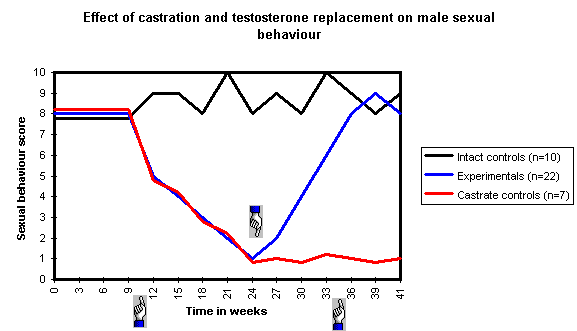
Effects of castration on sexual behaviour of males

In the experiment shown below, carried out on male guinea pigs (Grunt & Young, 1952), sexual behaviour decreased shortly after castration and was reestablished by the administration of testosterone to castrated animals. The hands on the figure point to weeks when these treatment changes occurred.
Effects of castration on sexual behaviour of males
Point to ponder
If you were called as an expert witness in the trial of a pedophiliac, what treatment would you recommend?

Hormones and Human Male Sexual Behavior

Heim and Hursch (Archives of Sexual Behaviour, 8, 281-304, 1979), reviewed the effects of castration on men convicted of sex crimes. Davidson et al (J. Clin. Endocrinol. Metab., 11, 599-623, 1982), studied the effects of androgen injections in men who had very low levels of testosterone circulating in their bodies (called hypogonadal).
Six patients each received: This study used a within-subjects design; each patient received each treatment. There was a gap of six weeks between treatments, and the order of treatments varied between patients to control for treatment order (carry over) effects.
This diagram shows that injection of testosterone enanthate increased plasma testosterone levels. Notice that the effect is dose-dependent, and temporary. Peak effects were seen seven days after injection.

The hypogonadal men kept daily diaries of their sexual behaviour and penile erections. The biggest effects of testosterone injections were reported one week after injection. This corresponds to the time of peak effect on plasma testosterone level. This diagram shows these effects. Notice that the effects are dose-dependent, and that the values do not reach 100% for any of the measures, even at the highest dose of testosterone (400 mg).

Of course one possibility is that not enough testosterone was injected. This is unlikely because studies indicate that plasma testosterone levels as high as 1500 ng/100 ml (the level seen after injection of 400 mg testosterone enanthate) are rare in normal men. In fact the most surprising thing about male testosterone level is its huge range - shown in red in the diagram below. In general there is a tendency for testosterone level to increase during teenage years and the 20s. it usually remains steady in middle life, but after 60 there is a decline to the level seen in young boys. Nevertheless as this diagram shows there are a lot of 90 year old men out there with teenage levels of circulating testosterone! (Vermeulen et al, J. Clin. Endocrinol. Metab.,34, 730-735, 1972).

Global Variation in Male Testosterone and Age by Peter T. Ellison et al at Harvard contains a nice diagram showing the decline in male salivary testosterone level as a function of age.
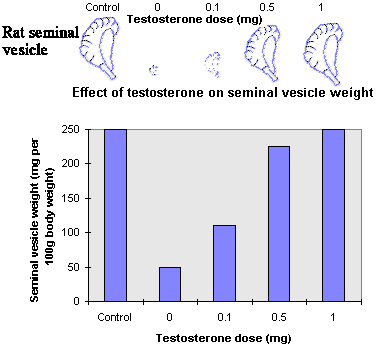

Effect of testosterone on seminal vesicle weight

It is tempting to think that the restoration of sexual behaviour in castrated male animals given testosterone replacement therapy is the result of the hormone reactivating 'centers' in the brain that control sexual motivation. This is an attractive hypothesis because it implies that these experiments will tell us something important about the relationship between brain and behaviour. However a more parsimonious explanation might be that castration somehow affects tissue outside the brain that is involved in sexual behaviour. For example the diagram below shows the effect of castration and testosterone replacement on seminal vesicle weight.
Effect of testosterone on seminal vesicle weight

Effect of hormones on papillae of glans penis in male rats

If you are still not convinced by this argument that recovery of sexual behaviour with testosterone replacement is the result of recovery of peripheral function, consider the figure below which shows the effect of castration and testosterone replacement therapy upon the number of genital papillae and the number of animals continuing to copulate four weeks after castration. The glans penis (tip of the penis) in the rat is covered in sensitive papillae. Maybe it's the recovery of sensation in this area that is responsible for the recovery of behaviour under testosterone therapy. All scores are expressed as percentages of the averages for normal rats (Data from Beach & Levinson, 1950). This experiment suggests that the effects of replacement testosterone on sexual behaviour could be mediated by changes in the sensitivity of the rats' penis rather than an effect of the hormone on brain tissue.
Effect of hormones on papillae of glans penis in male rats

Effects of central injection of hormones on sexual behaviour:

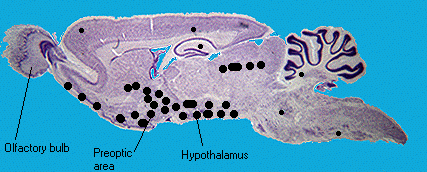
There are specific receptor sites in the brain that act as target cells for gonadal hormones released by the testes and ovaries. These are shown as black blobs in the diagram below. Receptor sites are particularly concentrated at the base of the brain in an area running from the preoptic area back to the hypothalamus ( but note that several other areas including the midbrain and hippocampus contain hormone receptor sites.) Implanting testosterone into the hypothalamic area in castrated male rats restores their sexual behaviour. Likewise estrogen implants in this area restore sexual behaviour in ovariectomised females. Implanting these hormones into other parts of the brain does not restore sexual behaviour which shows that the effects are site specific. Furthermore the brain implants are not associated with recovery of peripheral tissue that is hormone sensitive which indicates that the hormone has not leaked into the animals circulation and supports the conclusion that the restoration of behaviour is the result of the hormone affecting brain tissue that mediates sexual behaviour in normal animals.

hormone receptor sites


Maternal behaviour in the female rat

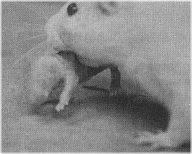
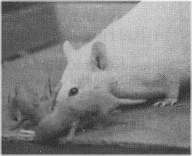
Although maternal behaviors - such as retrieval , shown in these pictures - are an important component of the reproductive behaviors of rats, discussion of this topic will be delayed until next year
retrievalretrieval

Supplementary Reading

HEFCE, the funding body for universities and colleges for the UK, has purchased a 3 year license to IDEAL, the Academic Press online journal library. If you are a member of a UK academic institution (i.e. HEFCE funded) you now have full access rights to this online library which enables you to read the full text of articles in Academic Press journals. Note IDEAL uses your computer's IP internet address to allow access. Consequently you may not gain automatic access if you are a HE student using a PC at home. 
The following articles cover topics raised in the lecture in greater depth:
  • Pfaus, FRANK BEACH AWARD. Homologies of animal and human sexual behavior. Hormones and Behavior, 30,3,187-200,1996. Follow this link to IDEAL
  • V. D. Ramirez,J. Zheng ,Membrane Sex-Steroid Receptors in the Brain, Frontiers in Neuroendocrinology, 17, 4, 402-439,1996. Follow this link to IDEAL
Other online resources
  • Global Variation in Male Testosterone and Age by Peter T. Ellison et al at Harvard contains a nice diagram showing the decline in male salivary testosterone level as a function of age.
  • NEERAJA SANKARAN, The Science Of Sex: What Is It And Who's Doing It? The Scientist, Volume 8, #6, page 3, 21 March 1994
  • Archives of Sexual Behavior, Volume 27 Number 1 Feb 1998. 'Pheromonal Influences on Sociosexual Behavior in Men' Winnifred B. Cutler Erika Friedmann Norma L. McCoy
    The Feb 1998 issue of Archives of Sexual Behavior is available free of charge. According to the authors "Significantly more pheromone than placebo users increased above baseline in sexual intercourse and sleeping with a romantic partner. There was a tendency for more pheromone than placebo users to increase above baseline in petting/affection/kissing, and informal dates, but not in self-stimulation to ejaculation or in formal dates . These initial data need replication but suggest that human male pheromones affected the sexual attractiveness of men to women. "
VIAGRA (sildenafil citrate) 
The Viagra story is interesting - in the context of this lecture - because it emphasizes the importance of peripheral factors in the control of sexual behaviour. 
A pill hailed as a "magic bullet" for the way it combats male impotence has created the greatest demand for a drug in the history of the American pharmaceutical industry. Originally developed as a heart medication, it is the first oral pill for impotence and it works for at least 70 per cent of sufferers. There are side effects. For example, about 16 per cent of men in the tests reported headaches. Another potential problem is that the drugs may mask early warning signs of heart disease.
The Virginia Urology Center explains Viagra's biochemical mechanism as follows: "To achieve an erection the brain produces a chemical (cyclic GMP) that relaxes specific muscles and allows the blood to flow into the penis. After orgasm, another chemical, (Phosphodiesterase) is produced to remove cyclic GMP, so blood can flow out of the penis. Viagra™ is a Phosphodiesterase Type (5 PDE-5) Inhibitor that, increases the time cyclic GMP is available to achieve or maintain an erection for sexual activities." 
The underlying mechanisms of male and female impotence may be similar. Female genitals fill with blood during sexual stimulation just as male genitals do, resulting in engorgement of the clitoris and lubrication of the vagina. Therefore female trials of Viagra are under way in Europe and the U.S

Figure 2. Percentage of Patients Reporting an Improvement in Erections. 
The following description of clinical studies of Viagra appeared on the Pfizer Viagra site 
" The frequency of patients reporting improvement of erections in response to a global question in four of the randomized, double-blind, parallel, placebo controlled fixed dose studies (1797 patients) of 12 to 24 weeks duration is shown in Figure 2. These patients had erectile dysfunction at baseline that was characterized by median categorical scores of 2 (a few times) on principal IIEF questions. Erectile dysfunction was attributed to organic (58%; generally not characterized, but including diabetes and excluding spinal cord injury), psychogenic (17%), or mixed (24%) etiologies. Sixty-three percent, 74%, and 82% of the patients on 25 mg, 50 mg and 100 mg of VIAGRA, respectively, reported an improvement in their erections, compared to 24% on placebo."
Further details can be obtained from the Pfizer Viagra site 
The Virginia Urology Center Impotence/Sexual Dysfunction site has detailed answers to the following questions:
     
  • How does an erection occur? 
  • What is impotence? 
  • What can cause impotence? 
  • How is impotence evaluated? 
What did you think of this learning resource? (e.g. loading speed, organization, detail & clarity of information)
Please type other comments here:

Read other peoples comments about this web site - the good & the bad!

If you find any other useful information that could be included here please send me the URL via email to Paul Kenyon